
- English Manor Labradoodle
How Big Do Labradoodles Get? Size, Weight, and Growth Stages
Quick Overview: How big do Labradoodles get? Labradoodles can vary significantly in size because they are bred from a Labrador Retriever and a Poodle, and the size of the Poodle parent plays a major role in determining adult height and weight. Depending on whether a Labradoodle is Miniature, Medium, or Standard, a full-grown dog may weigh anywhere from about 15 to 80 pounds or more and stand roughly 14 to 24 inches tall at the shoulder. Labradoodle Size at a Glance
Key Growth Facts
Did you know? Two Labradoodle puppies can look very similar when young, but end up dramatically different in adult size depending on the size of the Poodle parent and the genetics inherited from both sides of the family. While size can vary from one Labradoodle to another, understanding the dog’s size category and growth stages can provide a much clearer picture of what to expect as the puppy develops into adulthood. |
How Big Do Labradoodles Get? Size, Weight, and Growth Stages
One of the first questions prospective Labradoodle owners ask is, “How big will my Labradoodle get?” It is an important consideration because a dog’s adult size can influence everything from living space requirements and exercise needs to feeding costs and travel arrangements. Unlike many purebred dogs, which tend to fall within a predictable size range, Labradoodles can vary considerably depending on their breeding, genetics, and their parents’ size.
This variation often surprises new owners. Two Labradoodle puppies may look nearly identical at eight weeks old, but mature into very different-sized adults. Some remain compact enough to fit comfortably in smaller living spaces, while others grow into large, athletic dogs with a substantial presence. Because Labradoodles can be bred from Miniature, Medium, or Standard Poodles, there is no single “average” size that applies to every dog.
Understanding Labradoodle growth involves more than simply knowing their final weight. Puppies go through several distinct growth stages, each bringing changes in height, body structure, coat development, and overall appearance. By learning how size categories differ and what to expect during each stage of development, owners can gain a much clearer understanding of how their Labradoodle is likely to grow from a small puppy into a fully mature adult.
Did you know? Many Labradoodles reach most of their adult height before their first birthday, but they often continue developing muscle, body mass, and overall maturity for several months afterward.
How Big Do Labradoodles Get on Average?
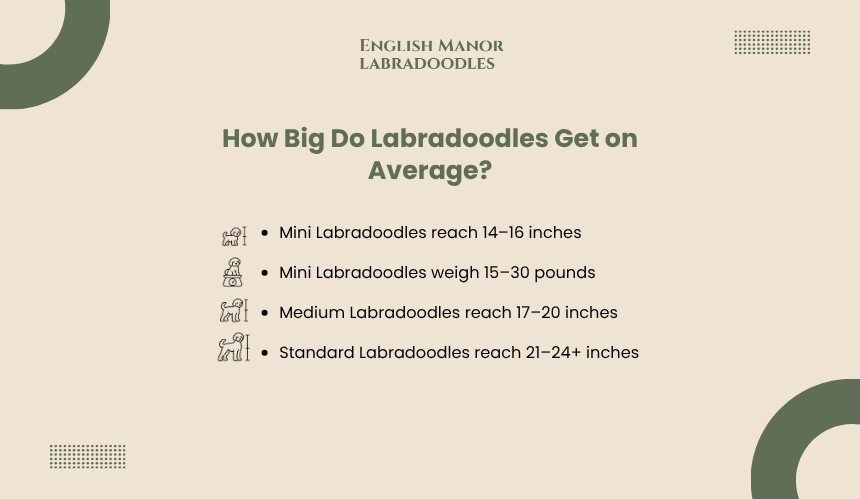
The size of a full-grown Labradoodle depends largely on the size of the Poodle parent used in the breeding program. Because Labradoodles are not all bred from the same type of Poodle, adult size can vary significantly from one dog to another. Most Labradoodles are classified as Miniature, Medium, or Standard, with each category having its own typical height and weight range.
Understanding these size categories provides the clearest answer to the question, “How big do Labradoodles get?”
Miniature Labradoodle Size
Miniature Labradoodles are the smallest variety and are typically produced by crossing a Labrador Retriever with a Miniature Poodle or through carefully planned multi-generational breeding programs. They are often chosen by owners who want the Labradoodle personality and appearance in a more compact package.
Most Miniature Labradoodles reach:
- Height: Approximately 14–16 inches at the shoulder.
- Weight: Around 15–30 pounds.
- Maturity: Usually reach their adult size earlier than larger Labradoodles.
Despite their smaller stature, Mini Labradoodles are generally energetic, athletic, and active dogs.
Medium Labradoodle Size
Medium Labradoodles fall between the Mini and Standard varieties. They are often considered a middle-ground option, providing a balance between manageability and the sturdy build associated with larger dogs.
Most Medium Labradoodles reach:
- Height: Approximately 17–20 inches.
- Weight: Around 30–50 pounds.
- Maturity: Typically reach full physical development between 12 and 18 months.
This size category is popular among families looking for a versatile companion that is neither too small nor excessively large.
Standard Labradoodle Size
Standard Labradoodles are the largest and most common size category. They are generally bred from Standard Poodles and Labrador Retrievers, resulting in a larger frame and greater overall weight.
Most Standard Labradoodles reach:
- Height: Approximately 21–24 inches or more.
- Weight: Around 50–80 pounds or higher.
- Maturity: May continue filling out well after their first birthday.
Because of their larger size, Standard Labradoodles often require more space and may take slightly longer to reach full physical maturity than smaller varieties.
Quick Labradoodle Size Comparison Table
Labradoodle Type | Height | Weight | Typical Age of Maturity |
Miniature Labradoodle | 14–16 inches | 15–30 pounds | 10–12 months |
Medium Labradoodle | 17–20 inches | 30–50 pounds | 12–18 months |
Standard Labradoodle | 21–24+ inches | 50–80+ pounds | 12–24 months |
Did you know? Two Labradoodle puppies from different litters can have dramatically different adult sizes even if they are the same age. Much of this variation comes from the size of the Poodle parent and the unique combination of genes inherited from both sides of the family.
What Determines a Labradoodle's Adult Size?
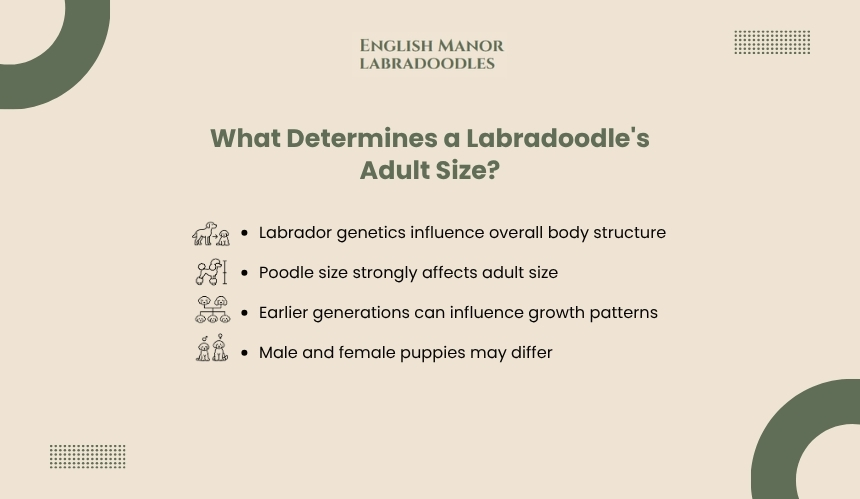
While Labradoodles are commonly grouped into Miniature, Medium, and Standard categories, predicting an individual puppy’s final size is not always straightforward. Adult height and weight are influenced by several factors, with genetics playing the most significant role. Understanding these influences can help owners develop more realistic expectations about how large their Labradoodle may become.
The Influence of the Labrador Retriever Parent
Every Labradoodle inherits part of its size potential from the Labrador Retriever side of the family. Labrador Retrievers are medium-to-large dogs known for their sturdy build, strong frame, and athletic body structure. These characteristics often contribute to the Labradoodle’s overall size, bone density, and physical appearance.
Depending on the individual Labrador parent’s genetics, puppies may inherit:
- A broader body structure.
- Larger paws and bone development.
- Greater muscle mass.
- A taller or more athletic frame.
Although the Labrador contributes significantly to the puppy’s growth potential, it is usually not the only factor determining final adult size.
The Influence of the Poodle Parent
The size of the Poodle parent is often one of the biggest predictors of how large a Labradoodle will become. Because Labradoodles may be bred using Miniature, Medium, or Standard Poodles, adult size can vary substantially between litters.
Generally:
- Miniature Poodles contribute to smaller Labradoodle sizes.
- Medium-sized Poodles often produce mid-sized offspring.
- Standard Poodles typically result in larger Labradoodles.
This is why two Labradoodle puppies may look similar when young but mature into very different-sized adults.
Did you know? The Poodle parent often has the greatest influence on a Labradoodle’s expected size category, which is why breeders typically classify Labradoodles as Mini, Medium, or Standard based largely on the Poodle lineage.
Genetics and Generation Differences
Even within the same size category, Labradoodles can vary because genetics are never completely predictable. Puppies inherit a unique combination of traits from both parents, grandparents, and earlier generations.
Factors that may influence adult size include:
- The size history of previous generations.
- Whether the dog is a first-generation or multi-generational Labradoodle.
- Natural genetic variation within the breeding line.
- Differences between male and female puppies.
As a result, even littermates may show slight differences in height and weight as they mature.
Nutrition and Early Development
Although genetics largely determine a Labradoodle’s growth potential, nutrition and overall health also play important roles during development. Proper feeding supports healthy growth, muscle development, and bone formation throughout puppyhood.
Healthy development is influenced by:
- Balanced puppy nutrition.
- Consistent veterinary care.
- Appropriate exercise and activity levels.
- Maintaining a healthy body condition during growth.
Nutrition cannot change a Labradoodle’s genetic size potential, but it can help ensure the puppy develops properly and reaches adulthood in healthy condition.
Did you know? Large and Standard Labradoodle puppies often continue adding muscle and body mass long after they have reached most of their adult height, which is one reason they may appear to “fill out” well into their second year.
Labradoodle Growth Stages: From Puppy to Adult
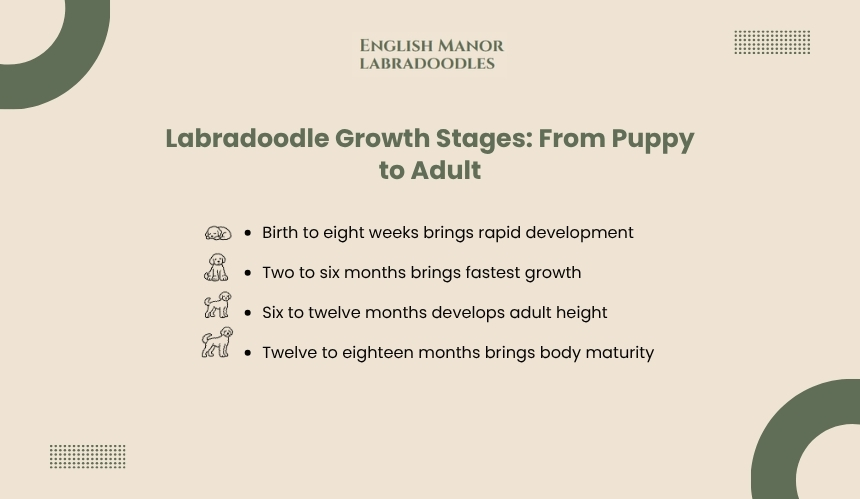
Labradoodles do not reach their adult size overnight. Like most dogs, they progress through several distinct growth stages that affect their height, weight, body shape, coat, and overall development. Understanding these stages can help owners recognize what is normal during each phase and set realistic expectations for their puppy’s growth.
Although growth rates vary between Mini, Medium, and Standard Labradoodles, most follow a similar developmental timeline.
Birth to 8 Weeks
The first eight weeks of life are marked by rapid development. During this stage, puppies rely heavily on their mother and littermates while experiencing significant physical and behavioral changes.
Key developments during this stage include:
- Rapid weight gain.
- Opening of the eyes and ears.
- Early social interactions with littermates.
- Initial coordination and mobility development.
- The beginning of personality traits becoming visible.
By the end of this period, most Labradoodle puppies are ready to transition to their new homes.
2 to 6 Months
This is often the fastest growth phase in a Labradoodle’s life. Puppies may appear to grow noticeably from week to week as their bones, muscles, and body structure develop rapidly.
During this stage, owners commonly notice:
- Significant increases in height and weight.
- Larger paws and longer legs.
- High energy levels and curiosity.
- Rapid learning and social development.
- Early changes in coat texture and appearance.
Many Labradoodles reach a substantial portion of their adult size during these months.
Did you know? A Labradoodle puppy that seems oversized for its age often has not finished growing. Large paws and long legs are common during rapid growth periods and do not necessarily indicate the dog’s final proportions.
6 to 12 Months
As puppies enter adolescence, growth slows compared to the earlier months, but development continues steadily. Most Labradoodles reach much of their adult height during this period, although their body structure is still maturing.
Common changes include:
- Continued increases in height and weight.
- More defined muscle development.
- Greater coordination and athletic ability.
- Ongoing behavioral maturation.
- Further coat development.
By the end of this stage, many Labradoodles look close to their adult size, even though they may still have additional growth ahead.
12 to 18 Months
Between one year and eighteen months, growth becomes more gradual. Rather than growing significantly in height, many Labradoodles begin to fill out and develop a more mature body shape.
Owners may notice:
- Increased muscle mass.
- A broader chest and stronger frame.
- More stable energy levels.
- Greater physical maturity.
- A more developed adult coat.
Medium and Standard Labradoodles are particularly likely to continue maturing during this period.
When Is a Labradoodle Fully Grown?
The answer depends on the dog’s size category. Smaller Labradoodles often mature more quickly than larger ones, while Standard Labradoodles may continue developing longer than Mini or Medium varieties.
Typical maturity timelines include:
- Mini Labradoodles: Around 10–12 months.
- Medium Labradoodles: Around 12–18 months.
- Standard Labradoodles: Around 12–24 months.
While many Labradoodles reach most of their adult height before their first birthday, full physical maturity usually occurs later, as the dog continues to build muscle and body mass.
Did you know? Many Labradoodles reach most of their height before they reach their final adult weight. It is common for a dog to appear fully grown in stature while still developing its mature body structure for several more months.
Labradoodle Weight by Age
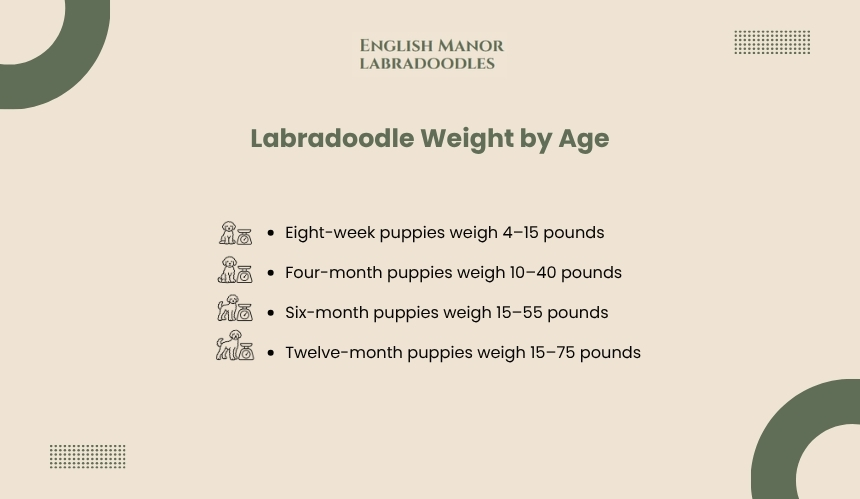
One of the most common questions new owners ask is how much their Labradoodle should weigh at different stages of development. While there is no exact weight that applies to every dog, general ranges can provide a helpful benchmark. Because Miniature, Medium, and Standard Labradoodles mature at different rates and reach different adult sizes, weight can vary considerably between puppies of the same age.
These ranges should be viewed as general guidelines rather than strict rules, since genetics, nutrition, activity level, and individual growth patterns all influence development.
Typical Weight at 8 Weeks
At around eight weeks of age, Labradoodle puppies are still very young and have only begun their growth journey. Size differences between Mini, Medium, and Standard Labradoodles may already be noticeable, although they often become more pronounced later.
Typical weight ranges include:
- Mini Labradoodle: 4–8 pounds
- Medium Labradoodle: 6–12 pounds
- Standard Labradoodle: 8–15 pounds
At this age, healthy puppies generally gain weight steadily as they adjust to life in their new homes.
Typical Weight at 4 Months
By four months, Labradoodles are usually in their fastest growth phase. Many puppies appear taller, leaner, and noticeably larger than they did only a few weeks earlier.
Approximate weight ranges:
- Mini Labradoodle: 10–18 pounds
- Medium Labradoodle: 15–30 pounds
- Standard Labradoodle: 25–40 pounds
Growth during this stage can occur in rapid bursts rather than at a perfectly consistent pace.
Did you know? Many Labradoodle puppies achieve nearly half of their expected adult weight within the first few months of life, making early puppyhood one of the fastest growth periods they will ever experience.
Typical Weight at 6 Months
At six months, most Labradoodles have completed a substantial portion of their overall growth. Although they still have plenty of development ahead, many owners begin to get a clearer picture of their puppy’s eventual adult size.
Approximate weight ranges:
- Mini Labradoodle: 15–25 pounds
- Medium Labradoodle: 25–40 pounds
- Standard Labradoodle: 35–55 pounds
By this age, growth may begin slowing compared to the rapid changes seen earlier in puppyhood.
Typical Weight at 12 Months
Around one year of age, many Labradoodles are approaching their adult size. Most have reached much of their adult height, although some continue adding muscle and body mass.
Approximate weight ranges:
- Mini Labradoodle: 15–30 pounds
- Medium Labradoodle: 30–50 pounds
- Standard Labradoodle: 50–75 pounds
Smaller Labradoodles may already be close to full maturity, while larger dogs often continue developing.
Typical Weight at Full Maturity
Adult weight depends on the Labradoodle’s size category and genetic background. Even within the same category, some dogs naturally fall near the lower or upper end of the range.
Average mature weights include:
Labradoodle Type | Adult Weight |
Miniature Labradoodle | 15–30 pounds |
Medium Labradoodle | 30–50 pounds |
Standard Labradoodle | 50–80+ pounds |
These figures represent typical ranges, but individual Labradoodles may be slightly larger or smaller depending on their genetics and overall development.
Did you know? Adult weight is often easier to estimate once a Labradoodle reaches six months of age, as growth patterns and body structure become much more apparent during the second half of the first year.
How Fast Do Labradoodles Grow?
Labradoodles are considered moderate-to-fast-growing dogs, especially during the first year of life. However, growth does not occur at the same pace from puppyhood to adulthood. Instead, Labradoodles experience several phases of development, beginning with rapid growth in the early months and gradually slowing as they approach maturity. The exact rate of growth depends on factors such as genetics, nutrition, overall health, and whether the dog is a Mini, Medium, or Standard Labradoodle.
Understanding these growth phases can help owners recognize what is normal and avoid expecting a perfectly linear growth pattern.
Rapid Puppy Growth Phase
The fastest period of growth typically occurs between two and six months of age. During this stage, Labradoodle puppies can gain weight and height surprisingly quickly. Many owners notice visible changes from month to month as their puppy develops longer legs, a larger frame, and a more athletic body structure.
This period is marked by significant skeletal growth and overall body development. Puppies often appear slightly awkward or out of proportion at times because different parts of the body do not always grow at exactly the same rate.
Did you know? It is common for Labradoodle puppies to go through temporary “gangly” stages during rapid growth, where their legs seem unusually long compared to the rest of their body.
Adolescent Growth Stage
Between six and twelve months, growth begins to slow, but development remains steady. During this stage, most Labradoodles continue increasing in height while also gaining strength and coordination. Their body proportions become more balanced, and they begin looking less like puppies and more like young adult dogs.
Although the dramatic growth seen earlier starts to taper off, many Labradoodles continue to gain considerable weight and muscle during this phase. Standard Labradoodles, in particular, often continue growing at a noticeable rate throughout much of their first year.
Slower Adult Development
After the first year, growth becomes much more gradual. At this point, many Labradoodles have reached most of their adult height, but they may continue filling out physically. The chest broadens, muscle mass increases, and the overall body structure matures.
This slower stage of development can continue for several months, especially in larger Labradoodles. While owners may not notice major changes in height, subtle improvements in strength, body condition, and overall maturity are still occurring.
Did you know? Many Standard Labradoodles appear fully grown by their first birthday, but they often continue to develop muscle and an adult body shape until 18 to 24 months of age.
Signs Your Labradoodle Is Growing Normally
Every Labradoodle develops at its own pace, which is why comparing one puppy directly to another can sometimes create unnecessary concern. While growth rates vary, several indicators generally suggest that a Labradoodle is progressing through its development in a healthy and expected way. Rather than focusing on a specific number on the scale, it is often more useful to look at the dog’s overall growth pattern, body condition, and physical development.
Healthy Weight Gain
A growing Labradoodle should gain weight steadily over time rather than experiencing dramatic fluctuations. Puppies typically become heavier as they grow taller, but healthy growth is usually gradual and consistent. Temporary growth spurts are normal, particularly during the first six months of life.
Owners often notice that a healthy puppy:
- Maintains a good appetite.
- Gains weight consistently over time.
- Appears energetic and active.
- Develops a balanced body condition as it matures.
The goal is steady development rather than rapid weight gain.
Consistent Height Development
Height growth is often most noticeable during the first year. Labradoodles generally become taller before they fully develop their adult body structure, which means they may appear lean or lanky during certain stages.
As long as the puppy continues to grow in proportion and maintain normal activity levels, these changes are often part of the natural growth process. Mini Labradoodles may complete much of their height growth earlier, while Standard Labradoodles often continue developing for a longer period.
Coat and Body Changes During Growth
One unique aspect of Labradoodle development is that their appearance can change significantly as they mature. Many puppies experience coat transitions during their first year, and their body shape gradually evolves from a puppy-like frame into a more mature structure.
Owners may notice:
- A thicker or more developed coat.
- Changes in coat texture or curl pattern.
- A broader chest.
- Increased muscle definition.
- A more balanced adult appearance.
These physical changes are often normal signs of ongoing development.
Did you know? Coat texture can continue changing throughout the first year of a Labradoodle’s life. Some puppies that appear wavy at a young age may develop curlier coats as they mature.
Energy and Behavioral Development
Growth is not limited to physical size. As Labradoodles mature, their behavior and energy levels also evolve. Young puppies are often highly energetic and curious, while older adolescents gradually develop better focus and self-control.
Many owners observe:
- Improved coordination and athletic ability.
- Increased confidence in new environments.
- Better responsiveness to training.
- More consistent daily routines.
These behavioral milestones often occur alongside physical development and can be useful indicators that a Labradoodle is progressing normally through its growth stages.
Did you know? Mental maturity often develops more slowly than physical maturity. A Labradoodle may look like an adult dog long before it consistently behaves like one.
Frequently Asked Questions
How big does a full-grown Labradoodle get?
A full-grown Labradoodle can range from approximately 15 to 80 pounds or more, depending on whether it is a Miniature, Medium, or Standard Labradoodle. Adult height typically ranges from about 14 to 24 inches at the shoulder.
At what age is a Labradoodle fully grown?
Most Labradoodles reach much of their adult height by 10 to 12 months. However, many continue gaining muscle, body mass, and physical maturity until 12 to 24 months of age.
How much should a Labradoodle weigh at six months?
Weight varies by size category. At six months, Mini Labradoodles often weigh 15–25 pounds, Medium Labradoodles 25–40 pounds, and Standard Labradoodles approximately 35–55 pounds.
Are Standard Labradoodles much bigger than Mini Labradoodles?
Yes. Standard Labradoodles are significantly larger, often weighing 50–80 pounds or more, while Mini Labradoodles generally weigh between 15 and 30 pounds when fully grown.
Can a Labradoodle's size be predicted from its parents?
While no prediction is exact, the size of the Labrador Retriever and especially the Poodle parent can provide a strong indication of a Labradoodle puppy’s likely adult size.
Do Labradoodles continue growing after one year?
Many Labradoodles do. Although most have reached their adult height by one year, larger Labradoodles often continue developing muscle, body mass, and overall maturity for several additional months.