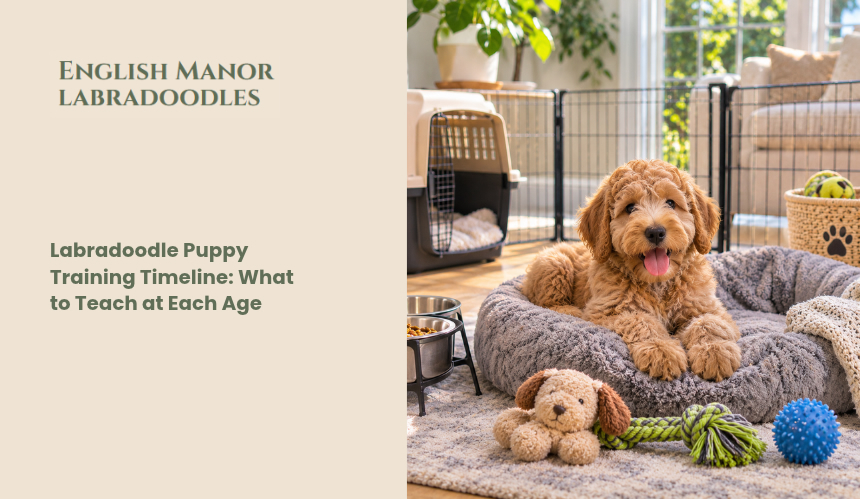
- English Manor Labradoodle
Labradoodle Puppy Training Timeline: What to Teach at Each Age
Quick Overview: A successful Labradoodle puppy training timeline focuses on teaching the right skills at the right age rather than trying to teach everything at once. During the earliest weeks, training should center on socialization, house training, crate training, and name recognition. As the puppy grows, owners can gradually introduce basic commands, leash skills, impulse control, and more advanced obedience. Because Labradoodles are intelligent and eager to learn, consistent age-appropriate training helps build confidence, good manners, and reliable behavior throughout adulthood. What to Teach at Each Age
Important Training Principles
Did you know? Labradoodles often learn routines and patterns very quickly, but their attention span develops gradually. Short, consistent training sessions are usually more effective than long lessons, especially during the first several months of life. The most effective training timeline is one that builds skills step by step. By focusing on age-appropriate goals and consistently reinforcing positive behaviors, owners can help their Labradoodle build a strong foundation in obedience, confidence, social skills, and everyday behavior. |
Labradoodles are widely recognized for their intelligence, eagerness to learn, and strong desire to interact with people. These qualities often make them highly trainable companions, but successful training involves more than simply teaching commands. Like children, puppies develop in stages, and the skills they are ready to learn at eight weeks old are very different from what they can successfully master at six months or one year of age. Understanding this progression can help owners focus on the right lessons at the right time.
One of the most common mistakes new owners make is trying to teach too much too quickly. While Labradoodle puppies are capable learners, their attention spans, confidence levels, and developmental abilities change significantly throughout puppyhood. Training that is introduced too early can lead to frustration, while waiting too long to introduce important skills may allow undesirable habits to develop. A structured training timeline helps create realistic expectations and ensures that learning progresses in a logical and manageable way.
The first year of a Labradoodle’s life is filled with important developmental milestones. Early weeks should focus on socialization, house training, and building trust, while later stages can introduce obedience, impulse control, and more advanced behavioral skills. By understanding what to teach at each age, owners can build a stronger foundation for future learning and help their Labradoodle become a confident, well-mannered, and reliable adult dog.
Did you know? Labradoodles often excel in training because they inherit both the intelligence of the Poodle and the people-oriented nature of the Labrador Retriever. However, even highly intelligent puppies learn best when skills are introduced gradually and reinforced consistently.
Why Training Should Follow a Developmental Timeline

Training is most effective when it matches a puppy’s developmental stage. While Labradoodles are known for being quick learners, they do not develop all skills at the same rate. A young puppy is still learning basic concepts such as attention, confidence, and routine, while older puppies are better equipped to handle more complex commands and behavioral expectations. Understanding these developmental differences helps owners create a more realistic and successful training plan.
Rather than rushing through commands, the goal should be to build a strong foundation that prepares the puppy for future learning.
Puppies Learn Differently at Different Ages
A puppy’s ability to understand and respond to training changes dramatically during the first year of life. Very young puppies are often focused on adjusting to their environment, recognizing familiar people, and learning basic routines. As they mature, they become more capable of understanding commands, controlling impulses, and maintaining focus for longer periods.
This developmental progression is why training recommendations often vary by age. Skills that are appropriate for an eight-week-old puppy may be too basic for a six-month-old Labradoodle, while advanced obedience exercises may be unrealistic for a very young puppy.
The Importance of Age-Appropriate Expectations
One of the most common causes of training frustration is expecting a puppy to perform beyond its developmental capabilities. Labradoodle puppies are intelligent, but intelligence does not eliminate the need for patience and gradual learning.
Age-appropriate expectations help owners:
- Focus on realistic goals.
- Build confidence through success.
- Reduce frustration during training.
- Encourage steady progress.
- Strengthen the bond between puppy and owner.
When training aligns with developmental readiness, learning tends to be more enjoyable and effective for both the puppy and the owner.
Did you know? A puppy that struggles with a particular command may not be stubborn. In many cases, the skill simply requires a level of focus or maturity that is still developing.
Building Skills Step by Step
Successful training often resembles a building process. Foundational skills learned early in life support more advanced behaviors later on. For example, a puppy that learns to focus on its owner is often better prepared for recall training, while a dog that understands basic obedience may find advanced commands easier to learn.
Each stage of training builds upon previous lessons. Early socialization supports confidence, confidence supports learning, and consistent learning helps develop reliable behavior over time. This gradual progression allows Labradoodles to develop strong training foundations while avoiding unnecessary pressure during important developmental stages.
Did you know? Short, consistent training sessions are often more effective for puppies than longer lessons because young dogs have limited attention spans and learn best through frequent repetition.
8 to 12 Weeks: Building the Foundation
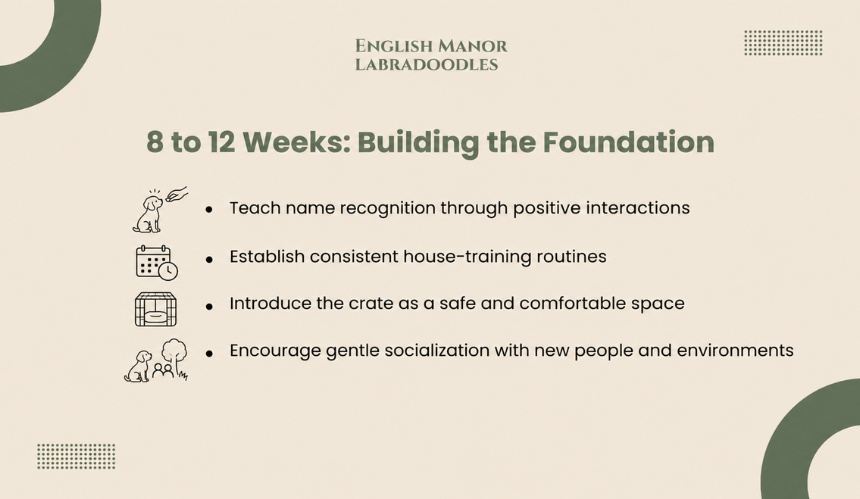
The period between eight and twelve weeks of age is often the most important stage in a Labradoodle puppy’s training journey. During this time, the puppy is adjusting to a new home, forming relationships with family members, and beginning to understand how the world works. Training at this age should focus on building trust, establishing routines, and creating positive experiences rather than expecting advanced obedience.
The lessons introduced during these early weeks often become the foundation for everything the puppy learns later in life.
Name Recognition
One of the first skills a Labradoodle puppy should learn is its name. Before puppies can reliably follow commands, they must first learn to pay attention when they are addressed.
Name recognition helps establish communication between the puppy and owner. Consistently using the puppy’s name in positive situations encourages attention and lays the groundwork for future training exercises.
House Training Basics
House training is typically a top priority during the first few weeks at home. At this age, puppies are still developing bladder control and require frequent opportunities to eliminate in appropriate locations.
Success during this stage often depends on consistency. Predictable schedules, supervision, and positive reinforcement help the puppy gradually understand where bathroom breaks should occur. Patience is important because accidents are a normal part of the learning process.
Did you know? Many house-training setbacks occur because puppies are given too much freedom too soon rather than because they are unable to learn the routine.
Crate Training Introduction
Crate training can help create a safe and comfortable space where the puppy can rest and relax. The goal is to help the crate become a positive environment rather than a form of punishment.
Early crate training often supports:
- House-training routines.
- Safe supervision.
- Travel preparation.
- Healthy sleeping habits.
- Independence and confidence.
Gradual introductions and positive experiences are typically the most effective approach.
Early Socialization Experiences
Socialization is one of the most valuable forms of training during this developmental stage. Labradoodle puppies benefit from positive exposure to people, sounds, surfaces, objects, and everyday experiences.
The focus should be on helping the puppy build confidence and familiarity with the world rather than overwhelming it with too many new experiences at once. Positive socialization can influence behavior and adaptability long after puppyhood.
Gentle Handling and Grooming Preparation
Labradoodles often require regular grooming throughout their lives, making early handling exercises especially beneficial. Introducing the puppy to gentle touching of the paws, ears, face, and body can help prepare it for future grooming sessions and veterinary visits.
These experiences help teach the puppy that handling is normal and safe. When introduced gradually and positively, grooming preparation can reduce stress and make future care routines much easier.
Did you know? Puppies that become comfortable with handling during their first few months often adapt more easily to grooming, nail trimming, ear care, and veterinary examinations later in life.
3 to 4 Months: Introducing Basic Commands

By three to four months of age, many Labradoodle puppies have become more comfortable in their homes and are ready to expand their training beyond the basics. This stage is often characterized by increased confidence, curiosity, and a growing ability to focus for short periods. While puppies are still easily distracted, they are usually capable of learning simple commands and beginning more structured training exercises.
The goal during this stage is to build on the foundation established during the first few weeks while keeping training positive, consistent, and age-appropriate.
Sit
“Sit” is often one of the first formal commands introduced during puppyhood. It is simple, practical, and can be used in many everyday situations.
Teaching sit helps:
- Encourage focus and attention.
- Introduce the concept of following commands.
- Support polite behavior around people.
- Build confidence during training sessions.
Because Labradoodles generally enjoy learning, many puppies pick up this command relatively quickly when training remains consistent.
Come When Called
Recall training is one of the most important skills a dog can learn. At this age, puppies are often naturally inclined to stay close to their owners, making it an excellent time to begin teaching reliable recall.
The emphasis should be on creating positive associations with coming when called. Every successful recall helps strengthen communication and establishes a foundation for more advanced training later.
Did you know? Reliable recall training often begins long before a puppy is ready for advanced off-leash work. Early positive experiences help create the habit of checking in with the owner.
Beginning Leash Training
Many Labradoodle puppies are introduced to leash walking during this stage. The focus should not be on perfect walking behavior but on helping the puppy become comfortable wearing a collar, harness, and leash.
Short training sessions can help the puppy learn:
- How to move comfortably while attached to a leash.
- How to follow gentle guidance.
- How to remain calm during walks.
- How to pay attention to the handler.
Patience is especially important because leash skills often take time to develop.
Focus and Attention Exercises
Before puppies can reliably follow commands, they must first learn to focus on their owner. Attention exercises help strengthen engagement and improve overall training effectiveness.
At this age, owners can begin encouraging:
- Eye contact.
- Responding to the puppy’s name.
- Brief periods of attention.
- Engagement during training sessions.
Strong focus skills often make future obedience training significantly easier.
Reinforcing House Training
Although house training begins earlier, it remains an important priority during this stage. Many puppies are making steady progress but still require supervision, routine, and consistency.
Owners should continue reinforcing established habits while gradually increasing expectations as bladder control improves. Consistent success helps strengthen the puppy’s understanding of household routines and appropriate bathroom behavior.
Did you know? Many Labradoodle puppies appear to understand house-training rules before they have fully developed the physical ability to follow them consistently. This is why continued supervision remains important even when progress seems strong.
4 to 6 Months: Expanding Training Skills
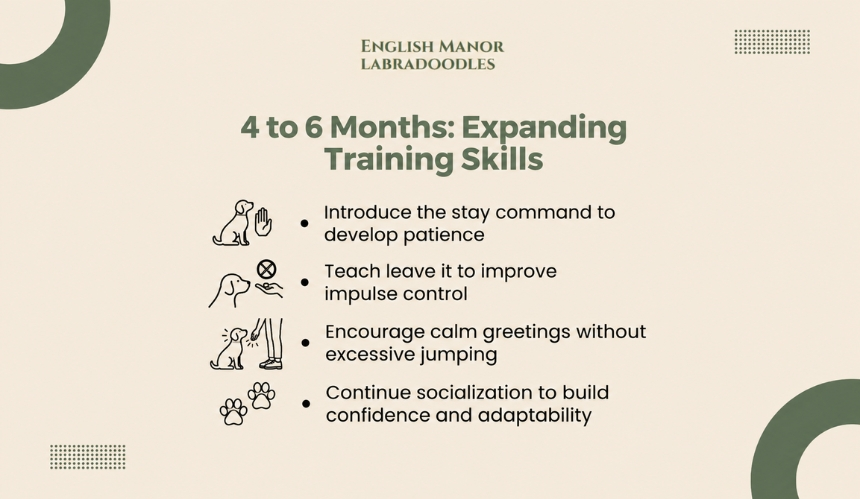
Between four and six months of age, Labradoodle puppies often become more confident, energetic, and independent. During this stage, they typically have a stronger understanding of basic commands and are ready to build upon the skills learned earlier. This is also a period when puppies may begin testing boundaries, making consistency and continued training especially important.
The focus should shift from simply introducing commands to improving reliability and encouraging better decision-making in everyday situations.
Stay
Once a puppy understands basic commands such as sit, many owners begin introducing the concept of stay. This command helps teach patience, self-control, and the ability to remain in position until released.
At this age, expectations should remain realistic. Puppies may initially be able to stay only a few seconds, but gradual practice helps build duration and reliability over time.
Leave It
“Leave it” is one of the most practical commands a Labradoodle can learn. Because puppies are naturally curious and often investigate objects with their mouths, teaching them to disengage from inappropriate items can be valuable in many situations.
This command helps establish:
- Better impulse control.
- Safer interactions with household objects.
- Improved focus on the owner.
- More reliable behavior in distracting environments.
Learning to ignore something can sometimes be just as important as learning what to do.
Did you know? Labradoodles are intelligent problem-solvers, which means they often discover creative ways to access items they find interesting. Commands like “leave it” help manage this natural curiosity.
Polite Greetings
Many Labradoodles are naturally friendly and enthusiastic around people. While this outgoing personality is often appreciated, puppies should also learn how to greet people calmly and appropriately.
Training during this stage can focus on:
- Remaining calm around visitors.
- Avoiding excessive jumping.
- Paying attention to the owner during greetings.
- Developing good manners around new people.
Teaching polite greetings early often helps prevent unwanted habits from becoming more difficult to manage later.
Continued Socialization
Although socialization begins during the earliest weeks of puppyhood, it should continue throughout this developmental stage. New experiences help reinforce confidence and encourage adaptability in different environments.
Exposure to a variety of situations, people, sounds, and locations helps puppies learn that unfamiliar experiences are a normal part of life. Consistent positive exposure supports both behavioral development and future training success.
Preventing Unwanted Behaviors
As Labradoodle puppies grow, they may begin to experiment with behaviors such as excessive chewing, jumping, leash pulling, or ignoring commands. Addressing these issues early is often easier than correcting established habits later.
The most effective approach is typically to redirect unwanted behavior toward appropriate alternatives while consistently reinforcing desirable choices. Early intervention helps maintain progress and encourages the development of good habits.
Did you know? Many Labradoodles begin testing boundaries around this age, making consistency especially important. Puppies often learn quickly which behaviors produce results, whether those results are intentional or not.
6 to 9 Months: Managing Adolescence
The period between six and nine months is often one of the most challenging stages of a Labradoodle’s training journey. Many puppies appear physically larger and more mature, but mentally they are entering adolescence. During this phase, owners may notice increased independence, selective listening, and occasional boundary testing. Behaviors that seemed reliable a few months earlier may suddenly become less consistent, which can be frustrating for inexperienced owners.
This stage is completely normal and should be viewed as an opportunity to strengthen existing training rather than start over. Consistency, patience, and regular practice are especially important during adolescence.
Strengthening Recall
Recall training becomes even more important as Labradoodles gain confidence and independence. While younger puppies often naturally stay close to their owners, adolescent dogs are more likely to become distracted by their surroundings.
Training during this stage should focus on improving responsiveness in a variety of environments. Practicing recall around increasing levels of distraction helps reinforce the habit of returning when called and strengthens communication between the dog and owner.
Improving Leash Manners
As Labradoodles grow larger and stronger, leash manners become increasingly important. Pulling that was once manageable in a small puppy can become much more difficult to control as the dog matures.
This stage is a good time to focus on:
- Walking calmly on a leash.
- Maintaining attention during walks.
- Responding to guidance.
- Remaining composed around distractions.
Consistent leash training helps create safer and more enjoyable walking experiences throughout adulthood.
Did you know? Many owners notice a temporary decline in leash manners during adolescence. This often reflects increased confidence and curiosity rather than a lack of intelligence or training ability.
Impulse Control Training
Adolescent Labradoodles often benefit from exercises that encourage patience and self-control. Because excitement levels can increase during this stage, learning to pause, wait, and make better decisions becomes an important part of training.
Impulse control exercises help develop:
- Patience around food and toys.
- Calm behavior before activities.
- Better decision-making.
- Increased focus despite distractions.
These skills support both obedience training and everyday household behavior.
Handling Increased Independence
A common characteristic of adolescence is growing independence. Labradoodles may become more interested in exploring their environment and less focused on their owners than they were during earlier stages.
Rather than viewing this as disobedience, owners should continue to reinforce positive behaviors and provide opportunities for successful training. Consistent guidance helps maintain strong habits while allowing the dog to mature and gain confidence.
Maintaining Consistency
Many training setbacks during adolescence occur because owners assume the dog no longer needs regular practice. In reality, this stage often requires continued reinforcement of previously learned skills.
Commands such as sit, stay, recall, and leash manners should remain part of the dog’s routine. Consistent expectations help prevent regression and encourage reliable behavior as the Labradoodle approaches adulthood.
Did you know? Adolescence is often when owners see the greatest improvements and the greatest challenges simultaneously. Dogs that continue to receive consistent training during this stage frequently emerge as adults with stronger obedience and better self-control.
9 to 12 Months: Building Reliability
By the time a Labradoodle reaches nine to twelve months of age, many basic commands and household expectations have already been introduced. The focus during this stage shifts from simply knowing a command to performing it reliably in a variety of situations. While adolescent behaviors may still occasionally appear, most Labradoodles are becoming better able to handle longer training sessions, greater distractions, and higher expectations.
This stage is about transforming learned skills into dependable behaviors that can be used consistently in everyday life.
Longer Stay Commands
At this age, many Labradoodles are ready to build upon the stay command introduced earlier. Rather than focusing only on short durations, training can gradually increase the amount of time the dog remains in position while maintaining attention and self-control.
The goal is not perfection but steady improvement. Increasing duration gradually helps strengthen patience and reinforces the dog’s ability to remain calm even when distractions are present.
Advanced Distraction Training
A command learned in a quiet room is very different from a command performed in a busy environment. During this stage, Labradoodles benefit from practicing previously learned skills around increasing levels of distraction.
Training in different locations helps improve:
- Recall reliability.
- Focus on people and animals.
- Obedience in unfamiliar environments.
- Confidence in new situations.
The ability to respond consistently despite distractions is often a major milestone in training development.
Did you know? Dogs do not automatically apply learned commands to every environment. Practicing skills in different locations helps Labradoodles understand that commands have the same meaning wherever they are.
Reliable Household Behavior
As Labradoodles mature, owners often place greater emphasis on everyday manners and behavior at home. By this stage, the dog should be developing a clearer understanding of household rules and expectations.
Training goals may include:
- Calm behavior around visitors.
- Appropriate interactions with family members.
- Reliable responses to everyday commands.
- Better self-control during daily activities.
Consistency remains important because reliable behavior is built through repetition and reinforcement over time.
Continued Confidence Building
Confidence development does not end after early socialization. Even older puppies benefit from positive experiences that encourage adaptability and resilience. New environments, controlled challenges, and ongoing social exposure help strengthen confidence and prevent fearfulness from developing.
A confident Labradoodle is often more willing to learn, more adaptable in unfamiliar situations, and better equipped to handle everyday experiences calmly.
Did you know? Many Labradoodles show significant improvements in focus and emotional maturity between nine and twelve months, making this an excellent time to reinforce training foundations and improve reliability before adulthood.
One Year and Beyond: Refining Adult Skills
Reaching one year of age does not mean a Labradoodle’s training is complete. While many dogs have developed a solid foundation in obedience and household manners by this stage, training should continue throughout adulthood. Labradoodles are intelligent, active, and eager to learn, which means ongoing training helps keep their minds engaged while reinforcing positive behaviors.
The focus after the first year shifts from teaching basic skills to improving reliability, introducing more advanced challenges, and maintaining the habits developed during puppyhood.
Advanced Obedience
Once a Labradoodle has mastered basic commands, owners can begin introducing more advanced obedience exercises. These activities help strengthen communication, improve responsiveness, and provide additional mental stimulation.
Advanced training may focus on:
- More reliable recalls.
- Longer stays.
- Greater responsiveness to distractions.
- Complex command sequences.
- Improved off-leash control where appropriate.
The goal is not necessarily competitive obedience but rather to create a well-mannered dog that responds consistently in everyday situations.
Lifelong Socialization
Many owners mistakenly assume socialization ends after puppyhood. In reality, continued exposure to new environments, people, and experiences helps maintain confidence and adaptability throughout a dog’s life.
Regular social experiences help:
- Reinforce positive behavior.
- Prevent fear of unfamiliar situations.
- Maintain confidence.
- Encourage calm interactions with people and other animals.
Consistent exposure supports emotional stability and helps dogs remain comfortable in a variety of settings.
Did you know? Socialization is not a one-time event. Dogs that continue experiencing new environments throughout adulthood often remain more adaptable and confident than those with limited exposure.
Mental Stimulation and Enrichment
Labradoodles are highly intelligent dogs that benefit from ongoing mental challenges. Without sufficient mental stimulation, some dogs may become bored and develop undesirable behaviors.
Activities that support mental enrichment include learning new commands, problem-solving games, training exercises, scent-based activities, and interactive play. Keeping the mind engaged can be just as important as providing physical exercise.
Ongoing Training Maintenance
Even well-trained adult dogs benefit from regular practice. Skills that are never reinforced may become less reliable over time, especially in distracting situations.
Continued training helps:
- Maintain obedience.
- Reinforce household manners.
- Strengthen communication.
- Build confidence.
- Keep learning enjoyable.
Rather than viewing training as something that ends after puppyhood, successful owners often treat it as a lifelong process that evolves alongside the dog.
Did you know? Many Labradoodles continue learning new skills well into adulthood when training remains consistent and engaging. Their intelligence and willingness to work with people often make them enthusiastic learners throughout their lives.
Common Training Mistakes by Age
Even with the best intentions, many Labradoodle owners make training mistakes that can slow progress or create unnecessary frustration. Most of these issues are not caused by a lack of effort but by a misunderstanding of what puppies can learn at different developmental stages. Recognizing these common mistakes can help owners set more realistic expectations and create a smoother training experience.
Successful training is often less about teaching more and more and more about teaching the right things at the right time.
Expecting Too Much Too Soon
One of the most common mistakes is expecting a young puppy to perform skills that require greater maturity, focus, or self-control. While Labradoodles are intelligent dogs, they are still puppies and need time to develop mentally and emotionally.
Training becomes more effective when owners:
- Focus on age-appropriate goals.
- Celebrate small successes.
- Build skills gradually.
- Understand that mistakes are part of learning.
Progress tends to be more consistent when expectations align with the puppy’s developmental stage.
Inconsistent Rules
Consistency is one of the foundations of successful dog training. Problems often arise when household expectations change from day to day or vary between family members.
For example, if a puppy is allowed to jump on people sometimes but corrected at other times, it may struggle to understand what behavior is expected. Clear and consistent rules help Labradoodles learn more quickly and reduce confusion during training.
Did you know? Dogs often learn patterns faster than individual commands. Consistent household expectations can significantly improve training progress by repeatedly reinforcing the same message.
Skipping Socialization
Many owners focus heavily on obedience while overlooking socialization. However, socialization is one of the most important aspects of a Labradoodle puppy’s development, particularly during the early months.
Insufficient socialization may reduce opportunities for the puppy to:
- Build confidence.
- Adapt to new environments.
- Interact comfortably with people.
- Handle unfamiliar experiences calmly.
Positive social experiences help support both behavioral development and future training success.
Neglecting Mental Exercise
Because Labradoodles are highly intelligent, they require more than just physical activity. A puppy that receives plenty of exercise but little mental stimulation may still become bored or frustrated.
Mental engagement can come from:
- Training sessions.
- Problem-solving activities.
- Interactive toys.
- Learning new commands.
- Controlled exploration experiences.
Training often becomes easier when a dog’s mental needs are being met alongside physical activity.
Stopping Training Too Early
Some owners reduce training once their Labradoodle begins responding reliably to basic commands. While this progress is encouraging, training should continue beyond puppyhood.
Skills become stronger through ongoing practice and reinforcement. Continuing to challenge the dog with new experiences and learning opportunities helps maintain obedience, improve reliability, and keep training enjoyable throughout adulthood.
Did you know? Many training setbacks occur not because a dog forgot a command, but because the skill was not practiced regularly enough to remain reliable in different situations and environments.
Frequently Asked Questions
When should I start training my Labradoodle puppy?
Training can begin as soon as a Labradoodle puppy comes home, often around eight weeks of age. Early training should focus on name recognition, house training, crate training, socialization, and building positive routines.
What command should I teach first?
Many trainers recommend starting with name recognition and basic attention exercises before introducing commands such as sit. Teaching a puppy to focus on its owner creates a strong foundation for future training.
How long should puppy training sessions be?
Young puppies generally learn best through short training sessions. Frequent sessions lasting a few minutes each are often more effective than longer lessons that exceed the puppy’s attention span.
When do Labradoodles enter adolescence?
Many Labradoodles begin entering adolescence between six and nine months of age. During this period, owners may notice increased independence, boundary testing, and occasional inconsistency with previously learned behaviors.
Are Labradoodles easy to train?
Labradoodles are generally considered highly trainable because of their intelligence, eagerness to learn, and strong desire to work with people. Consistency, positive reinforcement, and age-appropriate expectations often contribute to successful results.
What is the most important training during puppyhood?
Socialization, house training, recall development, and building positive relationships with people are among the most important priorities during puppyhood. These foundational skills often influence future behavior and learning success.