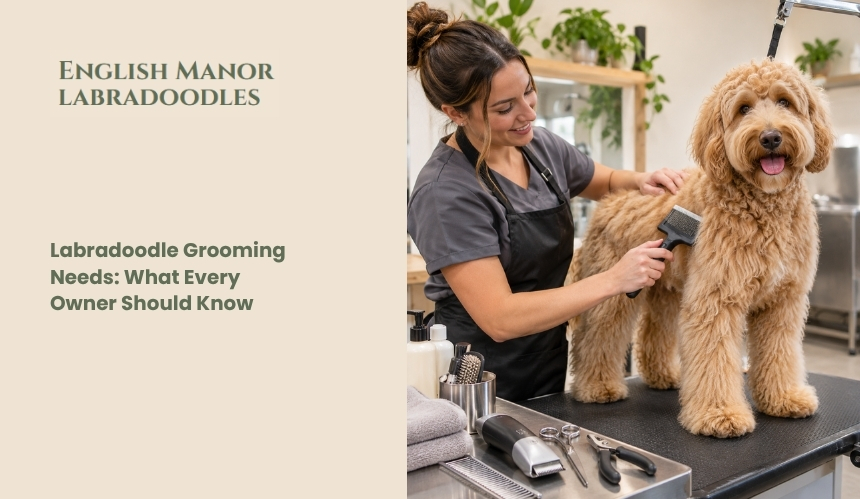
- English Manor Labradoodle
Labradoodle Grooming Needs: What Every Owner Should Know
Quick Overview: Labradoodle grooming needs are often more demanding than many new owners expect. Most Labradoodles require regular brushing, routine bathing, coat trimming, ear cleaning, nail maintenance, and ongoing coat care to keep their fur healthy and free of mats. The exact grooming routine depends largely on coat type, coat length, and lifestyle, but consistent maintenance is essential throughout the dog’s life. Key Labradoodle Grooming Facts
Did you know? A Labradoodle’s coat can continue changing during its first year of life. Some puppies develop curlier or denser coats as they mature, which can gradually increase their grooming requirements. Because Labradoodles inherit coat traits from both the Labrador Retriever and the Poodle, grooming needs can vary from one dog to another. Understanding your Labradoodle’s coat type and establishing a consistent grooming routine are the keys to maintaining a healthy, comfortable, and well-kept coat. |
Labradoodles are loved for their friendly personalities, intelligence, and distinctive coats. Their soft curls, loose waves, or fluffy fleece coats often create the impression that they are relatively easy to maintain. However, many first-time owners quickly discover that a Labradoodle’s coat requires much more attention than they initially expected. Without regular care, even a healthy coat can develop tangles, mats, and other grooming challenges that become increasingly difficult to manage over time.
One reason Labradoodle grooming can be confusing is that no two coats are exactly alike. Some Labradoodles inherit tighter Poodle-like curls, while others develop wavy fleece coats or straighter hair coats. Each coat type has its own maintenance requirements, so the grooming routine that works for one Labradoodle may not suit another. As the dog grows and its coat matures, grooming needs can change as well.
Many coat problems begin gradually. Small tangles behind the ears, under the collar, or around the legs may seem insignificant at first, but can quickly develop into larger mats if they are overlooked. Combined with routine bathing, trimming, ear cleaning, and nail care, coat maintenance becomes an important part of a Labradoodle’s overall health and comfort. Understanding these grooming needs early can help owners establish a routine that keeps their dog looking, feeling, and functioning at its best.
Did you know? Many Labradoodle owners are surprised to learn that coat maintenance often requires more consistency than coat length. Even a relatively short coat can develop mats if regular brushing and grooming are neglected.
Why Labradoodle Grooming Is Different From Many Other Breeds
Labradoodles are often described as low-shedding dogs, but low shedding does not necessarily mean low maintenance. In fact, many Labradoodles require more grooming attention than breeds that shed regularly. Their unique coat structure can trap loose hair, dirt, and debris, making routine grooming an important part of maintaining coat health and comfort.
Because Labradoodles inherit characteristics from both the Labrador Retriever and the Poodle, their grooming needs are often more complex than those of many other breeds.
The Unique Influence of Labrador and Poodle Genetics
A Labradoodle’s coat is the result of combining two very different breeds. Labrador Retrievers typically have a shorter, shedding coat that requires relatively simple maintenance, while Poodles have continuously growing hair that demands regular grooming and trimming.
As a result, Labradoodles may develop:
- Wavy coats that require frequent brushing.
- Dense curly coats that are prone to matting.
- Mixed coat textures with varying maintenance needs.
- Coats that continue changing as the dog matures.
This genetic variation is one reason grooming requirements can differ significantly from one Labradoodle to another.
Why Coat Maintenance Is So Important
Unlike some breeds where loose hair falls away naturally, many Labradoodles retain shed hair within their coat. If that hair is not removed through regular brushing, it can begin forming knots and mats that become increasingly difficult to manage.
Routine coat maintenance helps:
- Reduce tangles and matting.
- Distribute natural skin oils throughout the coat.
- Remove dirt and debris.
- Improve overall coat appearance.
- Support skin and coat health.
Consistent grooming is often easier than trying to correct coat problems after they have already developed.
Did you know? Low-shedding coats can actually require more grooming than heavy-shedding coats because loose hair often remains trapped within the coat rather than falling out naturally.
Common Grooming Challenges Owners Face
Many grooming challenges develop gradually and may not be immediately noticeable. Areas that experience friction or moisture are particularly vulnerable to matting and coat issues.
Common concerns include:
- Mats forming behind the ears.
- Tangles under collars and harnesses.
- Knots around the legs and tail.
- Moisture buildup around the beard and face.
- Coat maintenance is becoming more difficult between grooming sessions.
Understanding these problem areas allows owners to focus attention where grooming issues are most likely to occur and establish a more effective maintenance routine.
Did you know? A Labradoodle’s coat can continue changing during the first year of life. Some puppies develop thicker, curlier, or denser coats as they mature, which may gradually increase their grooming requirements.
Understanding Labradoodle Coat Types
One of the biggest factors influencing Labradoodle grooming needs is coat type. Labradoodles can inherit a wide variety of coat textures from their Labrador Retriever and Poodle ancestry, which means grooming requirements can vary significantly from one dog to another. Some coats are relatively easy to maintain, while others require frequent brushing and more intensive coat care to prevent matting.
Understanding your Labradoodle’s coat type is often the first step toward creating an effective grooming routine.
Wavy Fleece Coats
The fleece coat is one of the most common Labradoodle coat types. It typically has a soft, wavy appearance and is often considered a balance between the Labrador’s straighter coat and the Poodle’s tighter curls.
Fleece coats generally:
- Have a soft, silky texture.
- Range from loose waves to gentle curls.
- Require regular brushing to prevent tangles.
- Benefit from routine trimming to maintain manageability.
Many owners find fleece coats easier to maintain than tighter curly coats, although consistent grooming is still important.
Curly Wool Coats
Curly wool coats more closely resemble those of Poodles. These coats are often dense and tightly curled, giving the dog a fluffy appearance while also increasing grooming requirements.
Wool coats are commonly:
- Trap loose hair within the coat.
- Develops more quickly if neglected.
- Require frequent brushing and combing.
- Often need more regular professional grooming.
Because of their density, curly coats typically demand the highest level of coat maintenance among Labradoodle coat types.
Did you know? Curly Labradoodle coats may appear neat on the surface while mats develop beneath the coat, which is why thorough brushing is often more important than a quick surface groom.
Straight or Hair Coats
Some Labradoodles inherit a straighter coat that resembles the Labrador Retriever more than the Poodle. These coats are generally less curly and may require slightly less grooming than fleece or wool coats.
Straight coats often:
- Have fewer issues with severe matting.
- Require routine brushing to remove loose hair.
- May shed more than curlier coat types.
- Need ongoing maintenance to remain healthy and clean.
Although straighter coats can be easier to manage, they still benefit from regular grooming and coat care.
Which Coat Type Requires the Most Grooming?
Among the common Labradoodle coat types, curly wool coats usually require the most maintenance. Their dense curls can trap loose hair and create conditions where mats form quickly if brushing is inconsistent.
In general:
- Curly wool coats typically require the most grooming.
- Wavy fleece coats require moderate but consistent maintenance.
- Straight hair coats are often the easiest to maintain but may shed more.
Regardless of coat type, regular brushing, bathing, trimming, and coat inspections are essential for keeping a Labradoodle comfortable and maintaining overall coat health.
Did you know? Two Labradoodles from the same litter can develop noticeably different coat types, which means their grooming needs may differ even though they share the same parents.
How Often Should You Brush a Labradoodle?
Brushing is one of the most important aspects of Labradoodle grooming. Because many Labradoodles have coats that trap loose hair rather than shed it freely, regular brushing helps prevent tangles, mats, and coat compaction. Without a consistent brushing routine, small knots can quickly develop into larger mats that affect both the dog’s appearance and comfort.
The ideal brushing schedule depends on coat type, coat length, and activity level, but most Labradoodles benefit from brushing several times per week. Dogs with dense, curly coats often require more frequent attention than those with straighter or shorter coats.
Daily vs Weekly Brushing Needs
Not every Labradoodle requires the same brushing frequency. A Labradoodle with a short, well-maintained fleece coat may do well with brushing a few times each week, while a dog with a longer or curlier coat may need daily grooming to prevent tangles.
The key is consistency. Regular brushing sessions are generally much easier and more effective than allowing tangles to build up and attempting to remove them later. Establishing a routine also helps owners monitor coat condition and identify potential grooming issues before they become more serious.
Preventing Mats and Tangles
One of the primary goals of brushing is mat prevention. Mats form when loose hair becomes trapped and twists together, creating dense knots within the coat. These tangles often begin small and hidden beneath the outer layer of fur, making them easy to miss during casual grooming.
Frequent brushing helps separate the hair, remove trapped debris, and keep the coat properly maintained. It also improves air circulation through the coat and helps distribute natural oils that contribute to healthy skin and fur.
Did you know? A mat can begin forming long before it becomes visible on the surface. Some Labradoodles may appear well-groomed on the outside, while hidden tangles are developing close to the skin.
Areas Most Prone to Matting
Certain areas of a Labradoodle’s body are more vulnerable to mat formation because of constant movement, friction, and moisture exposure. These areas often require extra attention during grooming sessions.
The coat behind the ears, under the collar, around the neck, beneath the legs, around the tail, and along areas where harnesses or clothing create friction can develop tangles more quickly than other parts of the body. Regular inspection of these locations helps prevent small knots from becoming larger grooming problems.
Choosing the Right Grooming Tools
The effectiveness of brushing depends not only on frequency but also on the use of appropriate grooming tools. Different coat types may respond better to different brushes and combs, but the goal remains the same: to thoroughly reach through the coat to remove loose hair and detect developing tangles.
A proper grooming routine involves more than brushing the surface. The coat should be worked through carefully to ensure that hidden mats are not developing underneath. This approach helps maintain coat quality, improves comfort, and supports the Labradoodle’s overall grooming needs throughout its life.
Did you know? Many coat issues occur not because owners fail to brush their Labradoodle, but because brushing only reaches the top layer of the coat while tangles continue to form underneath.
Bathing and Coat Care Basics
Brushing is only one part of maintaining a healthy Labradoodle coat. Regular bathing and proper coat care also play an important role in keeping the coat clean, comfortable, and manageable. While Labradoodles do not usually require frequent bathing, establishing a consistent routine helps remove dirt, debris, and buildup that can affect both the coat and the skin underneath.
The goal is not simply to keep the dog looking clean, but to support long-term coat health while avoiding practices that may contribute to dryness, irritation, or increased matting.
How Often Should Labradoodles Be Bathed?
Most Labradoodles do not need weekly baths unless they are frequently exposed to mud, dirt, or outdoor activities that leave the coat heavily soiled. For many dogs, bathing every few weeks or as needed is sufficient to maintain cleanliness while preserving the natural oils that help protect the skin and coat.
Bathing too frequently can sometimes strip these natural oils, leaving the coat dry and more difficult to manage. The ideal schedule often depends on coat type, lifestyle, and overall coat condition rather than following a rigid timetable.
Choosing Appropriate Dog Shampoos
The products used during bathing can influence both skin health and coat quality. Labradoodles generally benefit from shampoos formulated specifically for dogs, as these products are designed to support the natural balance of canine skin and coat.
Using suitable grooming products helps maintain:
- Coat softness and manageability.
- Healthy skin condition.
- Natural moisture balance.
- Overall coat appearance.
Selecting products that match the dog’s individual coat and skin needs can contribute to a healthier grooming routine over time.
Did you know? A healthy Labradoodle coat often begins with healthy skin. Grooming products that support skin condition can have a noticeable impact on coat texture and appearance.
Drying the Coat Properly
Proper drying is an often-overlooked part of Labradoodle grooming. Leaving a dense coat damp for extended periods can encourage tangles and increase the likelihood of matting. Moisture trapped close to the skin can also affect the overall condition of the coat.
After bathing, the coat should be dried thoroughly while remaining free of tangles. This process helps maintain coat texture and makes future brushing sessions easier and more effective.
Maintaining Skin and Coat Health
Healthy coats are usually the result of consistent care rather than occasional intensive grooming. Regular brushing, appropriate bathing, proper drying, and routine coat inspections all work together to support coat quality throughout the dog’s life.
Owners should pay attention to changes such as excessive dryness, dull coat texture, increased tangling, or signs of skin irritation. Monitoring these changes as part of a regular grooming routine helps maintain both coat health and overall comfort.
Did you know? Many grooming problems that appear to involve the coat actually begin with underlying skin issues. Consistent coat care and routine observation can help identify changes before they become more noticeable.
Haircuts and Professional Grooming
For many Labradoodles, brushing and bathing alone are not enough to keep the coat in good condition. Because hair continues to grow and can become increasingly difficult to manage over time, routine trimming is often an important part of long-term coat maintenance. The frequency of haircuts depends on coat type, coat length, and the owner’s grooming preferences, but most Labradoodles benefit from regular trimming year-round.
Understanding when a haircut is needed and how professional grooming fits into a maintenance routine can help prevent many common coat problems before they develop.
How Often Do Labradoodles Need Haircuts?
Most Labradoodles require trimming every few weeks to keep the coat manageable and reduce the risk of matting. Dogs kept in longer coat styles often need more frequent maintenance than those with shorter trims because longer hair tends to tangle more easily.
The ideal grooming schedule varies from dog to dog, but regular trimming generally helps:
- Maintain coat manageability.
- Reduce tangles and mat formation.
- Improve overall cleanliness.
- Support healthy coat growth.
Rather than waiting until the coat becomes difficult to maintain, routine trimming helps keep grooming manageable year-round.
Popular Labradoodle Grooming Styles
Labradoodle owners often choose grooming styles based on coat type, climate, lifestyle, and personal preference. Some prefer shorter, low-maintenance trims that make brushing easier, while others choose fuller styles that highlight the breed’s characteristic appearance.
Regardless of the specific style selected, the primary goal should always be to maintain coat health and prevent excessive tangling. A well-maintained coat is typically easier to manage than a longer coat that receives inconsistent grooming.
Did you know? Shorter grooming styles do not eliminate the need for brushing. Even trimmed coats can develop tangles and mats if routine maintenance is neglected.
Signs It's Time for a Trim
A Labradoodle’s coat often provides clear indications that grooming is needed. Increased tangling, difficulty brushing through the coat, reduced visibility around the eyes, and excessive coat bulk can all signal that the coat has grown beyond a manageable length.
Owners may also notice:
- Brushing sessions are taking longer than usual.
- More frequent mat formation.
- Hair collects around the face and paws.
- A heavier or denser coat texture.
Recognizing these signs early helps prevent minor grooming challenges from becoming larger maintenance issues.
Professional Grooming vs At-Home Maintenance
While many owners successfully handle routine brushing and basic coat care at home, professional grooming often plays an important role in maintaining a Labradoodle’s coat over the long term. Professional groomers can help manage coat length, address developing mats, and maintain areas that may be difficult for owners to trim evenly.
The most effective approach is often a combination of both. Consistent at-home maintenance helps keep the coat healthy between appointments, while professional grooming supports long-term coat management and overall appearance.
Did you know? Many Labradoodle owners combine regular brushing at home with professional grooming appointments throughout the year. This combination often helps maintain coat quality while reducing the likelihood of severe matting and excessive coat growth.
Essential Grooming Beyond the Coat
When people think about Labradoodle grooming, they often focus exclusively on brushing and haircuts. While coat care is certainly important, a complete grooming routine involves much more than maintaining fur. Ear care, nail maintenance, dental hygiene, and routine facial cleaning all contribute to a Labradoodle’s overall comfort, health, and well-being.
Neglecting these areas can lead to problems that are often more significant than a tangled coat, which is why they should be included in every grooming routine.
Ear Cleaning
Labradoodles typically have floppy ears that can limit airflow within the ear canal. Moisture, dirt, and debris may become trapped more easily, particularly in dogs that swim frequently or spend a lot of time outdoors.
Regular ear inspections help owners identify excess wax, debris buildup, or other changes that may affect ear health. Keeping the ears clean and dry is an important part of routine grooming and can help support long-term comfort.
Did you know? The same floppy ears that give Labradoodles their distinctive appearance can also create an environment that retains moisture more easily, making routine ear care especially important.
Nail Trimming
Healthy nails are essential for proper movement and overall comfort. When nails become excessively long, they can affect posture, walking patterns, and daily activity.
Because nail growth rates vary between dogs, regular inspection is often more important than following a strict schedule. Consistent nail maintenance helps support normal movement and reduces the likelihood of discomfort caused by overgrown nails.
Dental Care
Oral health is another frequently overlooked aspect of grooming. Maintaining clean teeth and healthy gums contributes to overall well-being and can help reduce common dental issues that develop over time.
A consistent dental care routine helps:
- Maintain oral hygiene.
- Support gum health.
- Reduce plaque accumulation.
- Contribute to overall health and comfort.
Including dental care in a regular grooming schedule helps ensure that coat maintenance is not the only area receiving attention.
Eye and Facial Maintenance
The hair around a Labradoodle’s eyes, mouth, and facial area often requires regular attention. As the coat grows, facial hair can collect moisture, food particles, and debris, which may affect cleanliness and comfort.
Routine facial maintenance helps keep the area around the eyes clear and allows owners to monitor for irritation, excessive tearing, or other changes. When combined with regular coat care, facial grooming contributes to a cleaner, more comfortable appearance.
Did you know? Many Labradoodles require more frequent facial maintenance than full-body grooming because hair around the eyes and mouth tends to grow quickly and collect debris during everyday activities.
Common Labradoodle Grooming Mistakes
Even owners who groom their Labradoodles regularly can sometimes develop habits that make coat maintenance more difficult over time. Many grooming problems do not happen because grooming is completely neglected. Instead, they often result from small issues that gradually build up until the coat becomes harder to manage.
Understanding these common mistakes can help owners maintain a healthier coat and avoid preventable grooming challenges.
Waiting Too Long Between Brushings
One of the most common mistakes is assuming that occasional brushing is enough. Because many Labradoodle coats trap loose hair, tangles can begin forming long before they become visible on the surface.
When brushing is delayed for extended periods, small knots often tighten and combine with surrounding hair, making them more difficult to remove. Regular maintenance is generally far easier than trying to correct widespread matting after it develops.
Ignoring Small Mats
A small mat may not seem like a significant concern at first, but mats rarely remain small. As the dog moves, plays, and goes through daily activities, additional hair becomes trapped within the tangle, causing it to grow larger and denser.
Early detection is one of the most effective ways to manage coat health. Addressing minor tangles quickly often prevents them from becoming major grooming problems later.
Did you know? Many severe mats begin as tiny tangles hidden beneath the outer layer of the coat, making routine coat inspections just as important as brushing itself.
Using the Wrong Grooming Tools
Not every brush or comb is suitable for every Labradoodle coat type. Tools that work well on a straighter coat may be less effective on dense curls, while surface-brushing tools may fail to reach the deeper layers where mats often begin.
Using appropriate grooming equipment helps ensure that brushing reaches throughout the coat rather than only affecting the outer layer. Effective grooming depends as much on technique and tool selection as it does on frequency.
Skipping Routine Maintenance
Another common mistake is viewing grooming as a task that only needs attention when the coat looks messy. In reality, successful coat care is usually based on consistent maintenance rather than occasional intensive grooming sessions.
When routine brushing, coat inspections, ear care, nail maintenance, and trimming are postponed repeatedly, grooming challenges tend to accumulate. Establishing a predictable schedule helps keep the coat manageable and reduces the likelihood of larger problems developing.
Did you know? Many Labradoodle owners spend less time grooming overall when they follow a consistent routine, because short maintenance sessions are often easier than correcting weeks of neglected coat growth and matting.
Creating a Labradoodle Grooming Schedule
One of the best ways to manage Labradoodle grooming needs is to establish a consistent routine. Grooming is often much easier when it becomes part of a regular schedule rather than something that only happens when the coat starts looking messy. A structured approach helps prevent mats, keeps the coat healthier, and makes each grooming session more manageable.
The ideal schedule will vary depending on coat type, coat length, and lifestyle, but most Labradoodles benefit from a combination of daily, weekly, and long-term grooming tasks.
Daily Grooming Tasks
Daily grooming does not have to be time-consuming. Even a few minutes of attention can help identify developing tangles and keep the coat in better condition between more thorough grooming sessions.
Many owners use daily checks to:
- Inspect high-friction areas such as behind the ears and under the collar.
- Remove debris collected during walks or outdoor play.
- Check the facial area for moisture or buildup.
- Monitor the coat for early signs of tangles.
These quick inspections often help prevent small issues from becoming larger grooming challenges.
Weekly Grooming Tasks
Weekly maintenance is typically when most coat care occurs. Thorough brushing sessions help remove loose hair, detect hidden mats, and maintain coat quality.
For many Labradoodles, weekly grooming also includes:
- Full coat brushing and combing.
- Ear inspections and cleaning.
- Nail checks.
- General skin and coat assessment.
Consistency is often more important than the exact day of the week chosen for grooming.
Did you know? Many coat mats develop gradually over several weeks. Regular weekly grooming sessions often catch these tangles long before they become difficult to remove.
Monthly Grooming Tasks
Some grooming needs occur less frequently but remain important for long-term coat maintenance. Depending on coat growth and lifestyle, owners may schedule monthly bathing, more detailed grooming sessions, and additional coat-management tasks.
Monthly maintenance helps support:
- Coat cleanliness.
- Healthy skin condition.
- Manageable coat length.
- Overall grooming consistency.
These sessions also provide an opportunity to evaluate whether adjustments to the grooming routine are needed.
Long-Term Grooming Planning
Labradoodle grooming is not a one-time task but an ongoing commitment throughout the dog’s life. As the coat changes with age, seasons, and lifestyle, grooming needs may evolve as well.
Long-term planning often involves balancing at-home maintenance with periodic professional grooming appointments. By following a consistent schedule and adapting it to the dog’s individual coat type, owners can help maintain a healthy, comfortable coat while reducing the likelihood of matting, excessive tangles, and other common grooming problems.
Did you know? A consistent grooming schedule often reduces the total amount of grooming required over time because regular maintenance prevents many of the issues that make coat care more difficult later.
Frequently Asked Questions
How often should a Labradoodle be groomed?
Most Labradoodles benefit from brushing several times per week and regular coat maintenance throughout the year. Professional grooming or trimming is commonly needed every 6 to 12 weeks, depending on coat type and length.
Do Labradoodles need professional grooming?
Many Labradoodles benefit from professional grooming because their coats can become difficult to manage as they grow. Professional grooming is often combined with regular at-home brushing and coat maintenance.
Are Labradoodles high-maintenance dogs?
Compared with many breeds, Labradoodles often require more grooming. Their coats typically need consistent brushing, routine trimming, bathing, ear cleaning, nail care, and ongoing maintenance to prevent matting.
How often should I brush my Labradoodle?
The ideal brushing frequency depends on coat type and length. Many Labradoodles require brushing several times per week, while dogs with dense curly coats may benefit from daily brushing to prevent tangles.
What coat type requires the most grooming?
Curly wool coats generally require the most maintenance because they tend to trap loose hair and develop mats more quickly. Wavy fleece coats usually require moderate grooming, while straighter coats are often somewhat easier to maintain.
How do I prevent mats in a Labradoodle's coat?
Consistent brushing, regular coat inspections, proper bathing and drying, routine trimming, and close attention to high-friction areas such as behind the ears and under the collar can help prevent matting.