- englishmanor
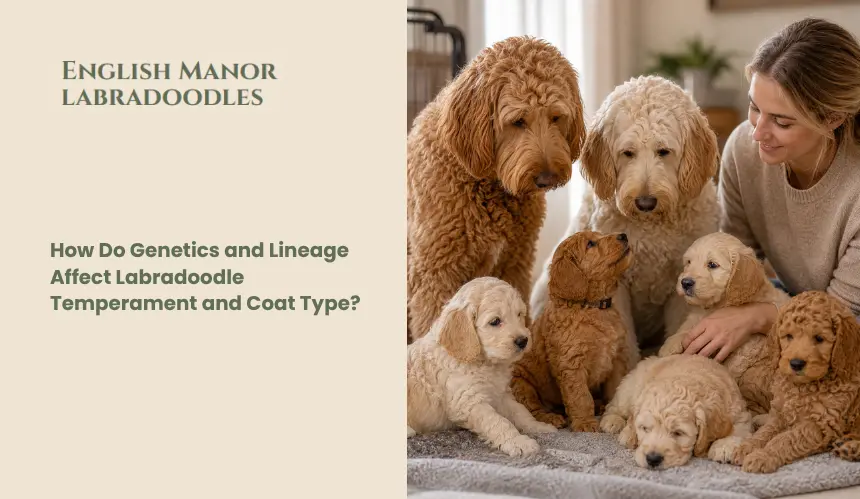
How Do Genetics and Lineage Affect Labradoodle Temperament and Coat Type?
|
Quick Overview: Genetics and lineage play a major role in shaping a Labradoodle’s temperament, coat type, shedding potential, and overall predictability. Because Labradoodles are a mixed breed, traits are inherited based on genetic probability rather than certainty. Lineage consistency, such as multigenerational breeding, helps reduce variation, while first-generation crosses often show wider differences in behavior, size, and coat texture. |
Labradoodles are often described as friendly, low-shedding, and highly adaptable, yet anyone who has compared multiple puppies quickly notices how different they can be from one another. Some mature into calm, steady companions with predictable coats, while others develop higher energy levels or coat textures that change dramatically over time. These differences are not random—they are rooted in genetics and lineage.
Understanding how genetic inheritance works helps explain why Labradoodles cannot be evaluated accurately based on appearance alone. Coat type, shedding potential, and core temperament traits are influenced by which genes are passed down and how consistently those traits have been selected over generations. By learning how genetics and lineage shape outcomes, buyers can move past assumptions and set expectations that align with biological reality rather than marketing descriptions.
Why Do Labradoodles Vary So Much in Temperament and Coat?
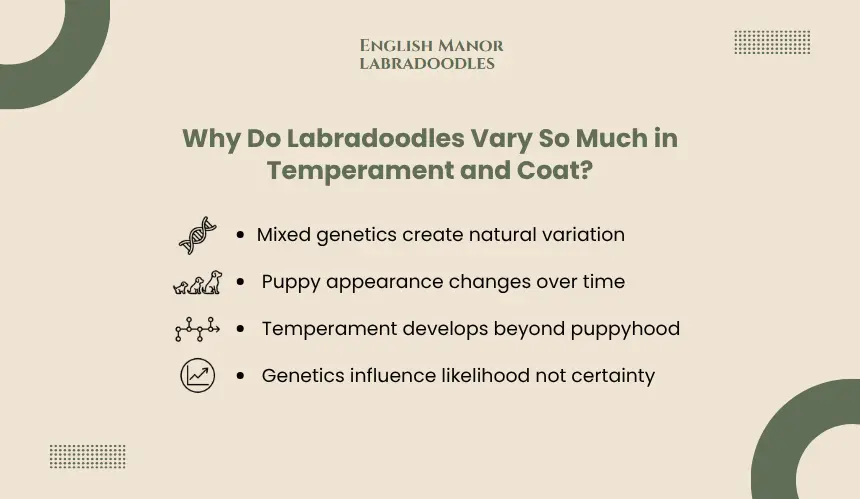
Wide variation is a natural outcome of how Labradoodles are bred. Unlike established purebred lines with tightly selected traits, Labradoodles inherit genes from two distinct breeds, each carrying its own behavioral tendencies and coat characteristics. The way these genes combine determines why two puppies from similar-looking parents can mature very differently.
How Mixed-Breed Genetics Create Variation
Labradoodles are the result of combining Labrador Retriever and Poodle genetics. Each parent contributes a unique set of dominant and recessive genes, and those genes are expressed in different combinations across a litter. This genetic reshuffling means that traits such as energy level, sensitivity, sociability, and coat texture can vary significantly, even among siblings.
Important note: Variation is not a sign of poor breeding on its own. It becomes a concern only when breeders make guarantees that genetics cannot reliably support.
Why Appearance at Eight Weeks Is Not Predictive
Puppy appearance often changes as adult coats develop. Coat texture, density, and shedding potential frequently shift during adolescence as adult hair replaces puppy fluff. Temperament also evolves as neurological development continues well past the early weeks.
Did you know? Canine development research shows that behavioral maturity continues well into the first 18–24 months, which is why early calmness or boldness does not always predict adult temperament.
How Genetics Influence Probability, Not Guarantees
Genetics establish a range of likely outcomes rather than fixed results. A puppy may carry genes associated with low shedding or steady temperament, but expression depends on which traits are inherited and how they interact.
Key genetic insight: Ethical breeders talk in terms of likelihood and patterns, not certainty. When outcomes are described as guaranteed, it usually reflects marketing language rather than genetic reality.
Recognizing that variation is a natural feature of Labradoodle genetics helps buyers evaluate puppies more realistically and understand why lineage consistency matters in shaping predictability over time.
How Do Labrador and Poodle Genetics Influence Labradoodle Traits?
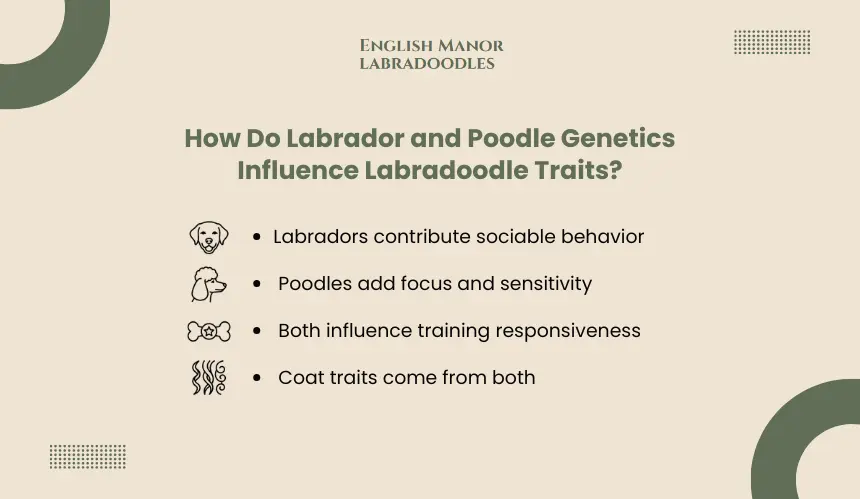
While Labradoodles share a common name, their traits reflect a blend of two very different genetic lineages. Labrador Retrievers and Poodles were developed for distinct working purposes, and those original roles still influence temperament and coat characteristics today. Understanding what each breed commonly contributes helps explain why Labradoodles display such a wide range of behaviors and physical traits.
What Temperament Traits Commonly Come From Labrador Lines?
Labrador genetics often contribute traits related to sociability and engagement. Many Labradoodles inherit a tendency toward enthusiasm, food motivation, and people-oriented behavior from their Labrador lineage.
Typical influences include:
- Strong interest in human interaction
- Motivation for play and reward-based training
- Steady confidence in familiar environments
These traits can support trainability, but they may also increase energy needs if not balanced with structure.
What Temperament Traits Are Often Inherited From Poodles?
Poodle genetics tend to influence sensitivity, focus, and problem-solving ability. Labradoodles with stronger Poodle influence may show higher awareness of their surroundings and greater responsiveness to training cues.
Key behavioral tendencies include:
- Heightened attentiveness to handlers
- Faster learning through repetition and consistency
- Sensitivity to changes in routine or environment
This sensitivity can be an advantage in training, but it also requires thoughtful handling and consistency.
How Coat Texture and Shedding Traits Are Passed Down
Coat characteristics are governed by multiple genes rather than a single factor. Labradoodles may inherit straight, wavy, or curly coats depending on which genetic combinations are expressed. Shedding potential follows the same pattern, which is why coat outcomes vary even within the same litter.
Important genetic fact: Shedding is influenced by several interacting genes, not coat curl alone. A curlier coat does not automatically mean lower shedding.
How Does Genetic Inheritance Affect Labradoodle Coat Types?
Labradoodle coats are one of the most visibly variable traits, and that variation is driven by how multiple coat-related genes interact, not by a single “doodle gene.” Understanding these inheritance patterns helps explain why coat outcomes can differ even when parents appear similar.
Why Labradoodle Coats Range From Straight to Curly
Coat texture is influenced by several genetic factors that control curl, length, and density. When Labrador and Poodle genes combine, puppies may inherit different combinations that result in straight, wavy, or curly coats.
Key genetic insight: Because multiple genes are involved, coat type is expressed along a spectrum rather than in fixed categories. This is why littermates can mature with noticeably different coat textures.
How Shedding Potential Is Genetically Determined
Shedding is influenced by genes related to hair growth cycles and coat structure. Labradoodles that inherit more Poodle-associated coat traits often shed less, while those with stronger Labrador influence may shed more seasonally.
Did you know?
Canine coat genetics research shows that shedding tendency is linked to hair growth patterns, not just curliness. A wavy or curly coat may still shed depending on the underlying growth cycle.
Why No Labradoodle Is Truly “Non-Shedding”
The idea of a completely non-shedding Labradoodle is a misconception. All dogs shed to some degree, even if hair loss is minimal or less noticeable.
Important note for buyers: Ethical breeders describe shedding in terms of reduced or lower likelihood, not absolutes. Claims of “guaranteed non-shedding” do not align with genetic reality.
How Does Lineage Influence Predictability in Labradoodles?
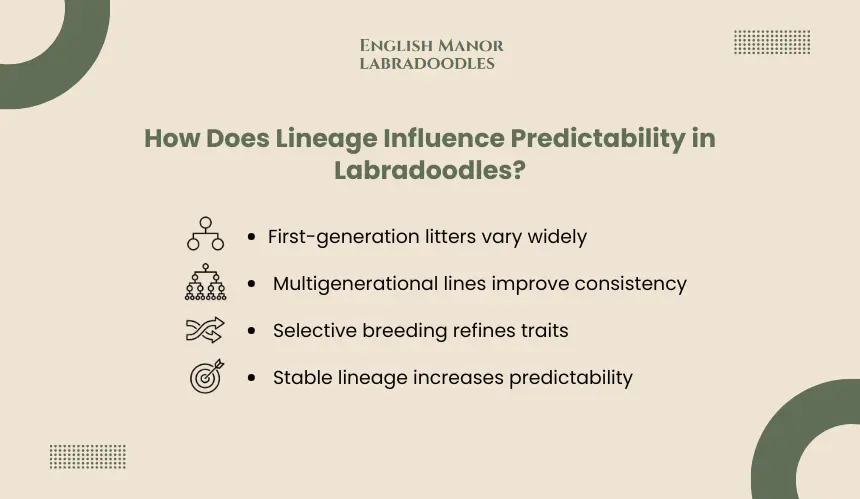
While individual genetics explain why Labradoodles vary, lineage explains how predictable those variations are likely to be. Lineage refers to how consistently traits have been selected and reinforced across generations, which directly affects reliability in temperament, size range, and coat outcomes.
What Is the Difference Between First-Generation and Multigenerational Labradoodles?
First-generation Labradoodles are produced by crossing a Labrador Retriever with a Poodle. Because the two parent breeds differ significantly, first-generation puppies often show the widest range of outcomes in behavior and coat type.
Multigenerational Labradoodles, by contrast, are bred from Labradoodles over multiple generations. This repeated selection narrows variability by reinforcing specific trait combinations over time.
Key distinction:
First-generation breeding introduces diversity; multigenerational breeding refines predictability.
Why Multigenerational Lineage Improves Predictability
When breeders consistently select dogs with similar temperaments, coat traits, and structural characteristics, those traits become more likely to appear in future litters. Predictability increases not because outcomes are guaranteed, but because variability is reduced.
Did you know?
Selective breeding research shows that trait consistency increases measurably after several generations of targeted selection, which is why established lineages are easier to evaluate than newly formed crosses.
How Inconsistent Lineage Increases Variation
When breeding decisions change frequently, such as alternating between different parent types or introducing unrelated lines, trait expression becomes less predictable. This can result in wider swings in coat texture, shedding potential, and energy levels across litters.
Important note for buyers: High variability is not inherently negative, but it requires flexibility. Buyers seeking specific traits should prioritize lineage consistency rather than isolated parent appearance.
How Do Genetics Shape Labradoodle Temperament Over Time?
Temperament is not fixed at puppyhood. While genetics establish a baseline for behavior, how those traits unfold depends on developmental timing and interaction with the environment. Understanding this progression helps explain why Labradoodles may change in energy, focus, or sensitivity as they mature.
Which Temperament Traits Are Strongly Influenced by Genetics?
Certain behavioral tendencies show moderate heritability, meaning they are more likely to be influenced by genetics than by environment alone. In Labradoodles, these often include baseline energy level, sociability, responsiveness to training, and sensitivity to stimuli.
Did you know?
Behavioral genetics studies estimate that traits like sociability and reactivity have heritability ranges of roughly 30–40%, indicating a meaningful but not exclusive genetic influence.
How Environment and Training Interact With Genetic Predisposition
Genetics shape potential, but environment determines expression. A genetically energetic Labradoodle may become well-regulated with structured exercise and training, while the same genetic profile may lead to restlessness without guidance.
Key insight: Training does not override genetics, it channels them. Ethical breeding paired with appropriate training produces more consistent outcomes than either factor alone.
Why Temperament Develops Beyond Puppyhood
Neurological and emotional maturity continues well into adolescence and early adulthood. Fear periods, confidence shifts, and changes in attention span are normal stages of development rather than signs of instability.
Important note for buyers: Early temperament observations provide clues, not conclusions. Ethical breeders and trainers evaluate temperament as a developing trait rather than a fixed label.
What Role Do Breeding Decisions Play in Temperament and Coat Outcomes?
Genetics set the range of possible traits, but breeding decisions determine which traits are more likely to appear together. Intentional selection, consistency, and restraint all influence whether Labradoodles develop balanced temperaments and manageable coat characteristics—or show wide, unpredictable variation.
How Intentional Pairing Influences Behavioral Stability
Ethical breeders pair dogs with complementary temperaments rather than relying on appearance alone. Matching calm with calm, or balancing sensitivity with steadiness, increases the likelihood of producing puppies with adaptable, trainable dispositions.
Did you know?
Selective breeding research shows that behavioral consistency improves when temperament is evaluated across multiple contexts, not just observed briefly, one reason intentional pairing outperforms convenience-based breeding.
Why Random Pairing Leads to Unpredictable Results
When pairings are driven by availability, demand, or trends, genetic outcomes become harder to predict. Random pairing increases the chance that contrasting traits, such as high reactivity combined with high energy, will appear together, complicating training and management.
Key insight: Unpredictability is not caused by mixed breeding itself, but by lack of selection criteria.
How Ethical Breeding Reduces Extreme Outcomes
Ethical breeding aims to narrow extremes, not eliminate individuality. By selecting for moderate energy, stable responsiveness, and compatible coat traits over time, breeders reduce the likelihood of outlier outcomes such as excessive shedding, extreme sensitivity, or mismatched energy levels.
Important note for buyers: When breeders explain why specific dogs were paired and what patterns they’ve observed across litters, it’s a strong indicator that outcomes are being shaped deliberately rather than left to chance.
Quick Size and Lifestyle Guide Based on Genetics and Lineage
Use this table to align home environment, activity level, and grooming expectations with likely Labradoodle traits. Every dog is an individual, but genetic patterns and lineage consistency help set realistic expectations.
|
Type |
Typical Height |
Energy Level |
Best Home Match |
Grooming Needs |
Training Ease |
|
Smaller-frame Labradoodle |
14–17 inches |
Moderate |
Apartments or smaller homes with structured daily walks |
Moderate to high due to finer coat texture |
High with consistent routines |
|
Medium-frame Labradoodle |
17–21 inches |
Moderate to high |
Active households with regular outdoor activity |
High, requires ongoing brushing and professional grooming |
High when training starts early |
|
Larger-frame Labradoodle |
21–24 inches |
High |
Homes with yards or highly active lifestyles |
Moderate to high depending on curl and density |
Moderate to high with structure |
|
First-generation lineage |
Highly variable |
Variable |
Owners flexible with outcomes and coat changes |
Unpredictable shedding and grooming demands |
Variable depending on temperament mix |
|
Multigenerational lineage |
More consistent |
More predictable |
Owners seeking routine and stability |
More predictable coat maintenance |
Generally higher due to behavioral consistency |
How to Interpret This Table Correctly
- Height ranges reflect genetic tendency, not adult guarantees
- Energy level correlates with temperament genetics and pairing decisions
- Grooming needs are driven by coat genetics, not puppy appearance
- Training ease improves with lineage consistency and temperament selection
Did you know? Canine genetics research suggests that predictability of physical and behavioral traits increases noticeably after several generations of selective breeding, which is why multigenerational Labradoodles tend to show more stable outcomes than first-generation crosses.
What Common Myths Exist About Labradoodle Genetics?
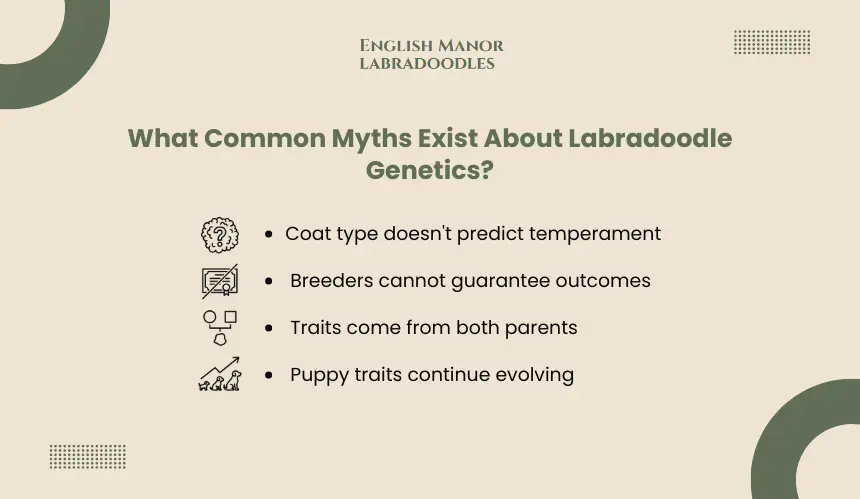
Genetics are often oversimplified in conversations about Labradoodles, which leads to expectations that biology cannot realistically support. Addressing these myths helps buyers interpret breeder claims more accurately and avoid assumptions that conflict with genetic science.
Is Coat Type Linked to Temperament?
Coat type and temperament are controlled by different sets of genes. A Labradoodle’s curliness or shedding potential does not determine whether the dog will be calm, energetic, sensitive, or outgoing.
Important clarification: A curly coat may coexist with a wide range of temperaments, just as a straighter coat can. Associating behavior with coat appearance is a common misconception rather than a genetic rule.
Can Breeders Guarantee Coat or Personality Outcomes?
No breeder can guarantee exact coat type, shedding level, or adult temperament. Genetics operate on probability, and even well-planned breeding programs cannot control every variable.
Did you know?
In canine genetics, polygenic traits, those influenced by multiple genes, such as coat and behavior—are inherently variable, which is why ethical breeders describe outcomes in terms of likelihood rather than certainty.
Does One Parent Determine All Traits?
Traits are not inherited entirely from one parent. Each puppy receives a mix of genes from both parents, and different combinations are expressed across a litter.
Key insight: Even when one parent strongly exhibits a desirable trait, that trait may not appear uniformly in all puppies. This is why lineage consistency matters more than focusing on a single parent.
Are Labradoodle Traits Fully Apparent in Puppyhood?
Many traits develop over time. Coat texture often changes as adult hair replaces puppy coat, and temperament continues to mature through adolescence.
Important note for buyers: Early observations provide indicators, not final outcomes. Ethical breeders account for this developmental window when discussing expectations.
Frequently Asked Questions
Do Labradoodles have predictable temperaments?
Labradoodle temperament follows genetic patterns, not guarantees. Lineage consistency and intentional breeding improve predictability, but individual variation remains due to polygenic inheritance and developmental factors.
Can you tell a Labradoodle’s adult coat type as a puppy?
Adult coat type cannot be confirmed in early puppyhood. Coat texture and shedding potential often change as adult hair develops, which is why early appearance should not be treated as definitive.
Are multigenerational Labradoodles more consistent than first-generation crosses?
Yes. Multigenerational Labradoodles tend to show greater consistency in coat and temperament because traits have been selectively reinforced across multiple generations.
Does training change genetic temperament traits?
Training does not change genetic predisposition, but it strongly influences how traits are expressed. Structure and guidance help channel inherited energy, sensitivity, and sociability into balanced behavior.
Why do Labradoodles from the same litter behave differently?
Each puppy inherits a different combination of genes. Even littermates can express traits differently due to genetic variation and individual developmental experiences.
Should buyers rely on breeder guarantees about coat or behavior?
Guarantees around coat type or temperament should be viewed cautiously. Ethical breeders discuss probabilities, patterns, and lineage history rather than promising fixed outcomes.