- englishmanor
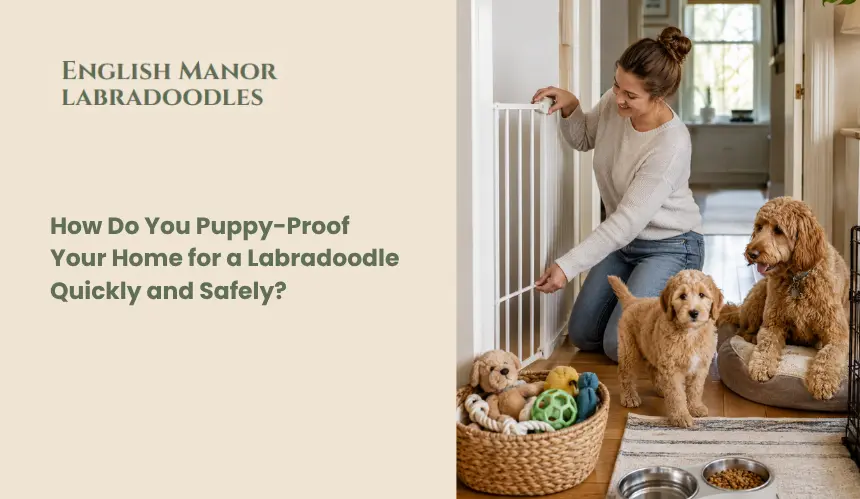
How Do You Puppy-Proof Your Home for a Labradoodle Quickly and Safely?
Quick Overview: To puppy-proof your home for a Labradoodle, secure electrical cords, remove toxic plants, lock away chemicals and medications, block unsafe areas, secure garbage containers, and create a designated puppy zone. Labradoodles are highly curious and energetic, so proactive preparation reduces injury risk, prevents destructive chewing, and minimizes emergency veterinary visits during early development. |
Bringing home a Labradoodle puppy means preparing for intelligence, energy, and nonstop curiosity. These dogs explore with their noses and mouths, investigate moving objects, and quickly learn how to access things that seem out of reach. Without preparation, everyday household items can become hazards within minutes.
Did You Know?
Accidental ingestion of household objects and exposure to toxic substances are among the most common emergency issues seen in young puppies during their first year.
Puppy-proofing is not about restricting movement; it is about creating a safe environment where exploration does not lead to injury. Electrical cords, unsecured trash, cleaning supplies, small objects, and even decorative plants can pose serious risks. Labradoodles, in particular, tend to chew during teething and investigate spaces that smaller breeds may ignore.
A proper strategy combines hazard removal, containment planning, supervision, and early training. The goal is controlled freedom, allowing the puppy to learn and grow safely.
To build an effective plan, it’s important to first understand why puppy-proofing is especially essential for this breed.
Why Is Puppy-Proofing Essential for Labradoodles?
Puppy-proofing is critical because Labradoodles combine intelligence, athletic ability, and strong oral curiosity. As a cross between the Labrador Retriever and Poodle, this breed tends to explore actively and problem-solve quickly. Without environmental safeguards, that curiosity can lead to chewing, ingestion, falls, or exposure to toxins.
Did You Know?
Foreign body ingestion, including socks, small toys, and household items, is one of the leading causes of intestinal obstruction surgery in young dogs.
How Does Breed Temperament Increase Household Risk?
Labradoodles typically inherit:
- A strong retrieving instinct (picking up objects with their mouth)
- High energy levels
- Fast learning combined with fast exploration
- Physical agility that allows access to countertops and furniture
This means unsecured items on tables, dangling electrical cords, or open cabinets are easily investigated.
Because they are intelligent, Labradoodles also remember access points. If a trash bin is successfully opened once, the behavior is likely to repeat.
What Are the Most Common Indoor Hazards for Puppies?
Several household risks consistently appear in veterinary cases:
- Electrical cords and power strips (chewing can cause burns or electrocution)
- Toxic plants such as lilies or pothos
- Cleaning chemicals and disinfectants
- Human medications
- Small swallowable objects like hair ties or children’s toys
Organizations such as the ASPCA regularly report plant toxicity and medication ingestion among common emergency calls.
Why Is Early Prevention More Effective Than Correction?
Once a puppy practices chewing furniture legs or raiding trash bins, the behavior becomes reinforced. Prevention removes the opportunity before habits form. It is far easier to prevent destructive chewing than to reverse it later.
Puppy-proofing, therefore, protects both safety and long-term behavioral development.
Next, it’s important to understand the broader benefits of proper puppy-proofing beyond just injury prevention.
What Are the Benefits of Proper Puppy-Proofing?
Puppy-proofing is often viewed as a short-term safety measure, but its benefits extend beyond preventing accidents. A structured environment supports behavioral development, reduces stress for owners, and strengthens early training outcomes.
Did You Know?
Early environmental management significantly reduces the likelihood of destructive habits forming during the teething phase, which typically intensifies between 3 and 6 months of age.
How Does Puppy-Proofing Reduce Veterinary Emergencies?
By securing electrical cords, locking away cleaning agents, removing toxic plants, and eliminating access to small swallowable objects, the risk of ingestion, poisoning, and traumatic injury drops significantly. Preventative preparation minimizes the chance of emergency interventions such as obstruction surgery or toxin treatment.
How Does It Prevent Destructive Chewing?
When unsafe or inappropriate items are removed, puppies are more likely to engage with designated chew toys. Environmental control prevents reinforcement of unwanted behaviors. Labradoodles, due to their strong retrieving instinct, are especially prone to picking up and chewing loose objects when they are accessible.
How Does It Support Training and Confidence?
A safe, structured environment reduces confusion. Clear boundaries allow the puppy to learn appropriate behavior more quickly. When hazards are removed, supervision becomes more productive, and training sessions can focus on skill-building rather than constant interruption.
How Does It Reduce Owner Stress?
Knowing that trash bins are secured, chemicals are stored properly, and dangerous areas are blocked allows owners to supervise calmly. Reduced anxiety leads to more consistent training and better communication between owner and puppy.
What Is the Step-by-Step Guide to Puppy-Proofing Your Home?
Puppy-proofing should be systematic rather than random. Moving room by room ensures no hazards are overlooked. The objective is to remove risk, restrict unsafe access, and prepare the space for safe exploration.
Did You Know?
Most preventable puppy injuries occur in familiar home environments, not outdoors, because owners assume everyday spaces are already safe.
Inspect Each Room at Puppy Level
Begin by lowering your perspective. Scan each room from the puppy’s height to identify dangling cords, reachable shelves, unstable décor, or swallowable objects. Items that seem insignificant at adult eye level can become immediate targets for a curious Labradoodle.
Look behind furniture, under tables, and near baseboards.
Secure Electrical Cords and Power Sources
Bundle loose cables and use cord protectors to prevent chewing. Power strips should be elevated or hidden behind furniture. Labradoodles often chew during teething, and exposed wiring poses electrocution and burn risks.
Curtain pull cords should also be shortened or secured to prevent entanglement.
Store Hazardous Items Safely
Cleaning agents, disinfectants, essential oils, and medications should be placed in locked cabinets or on high shelves. Childproof cabinet locks are effective in low-storage areas.
Even small quantities of certain substances can cause poisoning in young dogs.
Remove Toxic Plants
Review indoor houseplants and relocate any varieties known to be harmful to dogs. Some common decorative plants contain compounds that cause gastrointestinal distress or more serious complications if ingested.
Secure Garbage Containers
Trash bins should have tight-fitting lids or locking mechanisms. Labradoodles are strong enough to tip over lightweight bins. Food waste, bones, and packaging materials are common ingestion hazards.
Check Doors and Windows
Ensure door latches close fully and window screens are secure. Puppies can push through weak screens or slip through partially open doors. Sliding doors should lock properly.
Block Access to Small or Unsafe Areas
Prevent entry behind appliances, into crawl spaces, or under furniture where a puppy could become trapped. Use baby gates to block staircases or rooms that cannot be fully secured.
Once the interior is secured, the next step is creating a designated safe zone that supports supervision and early training.
How Should You Create a Safe Puppy Zone?
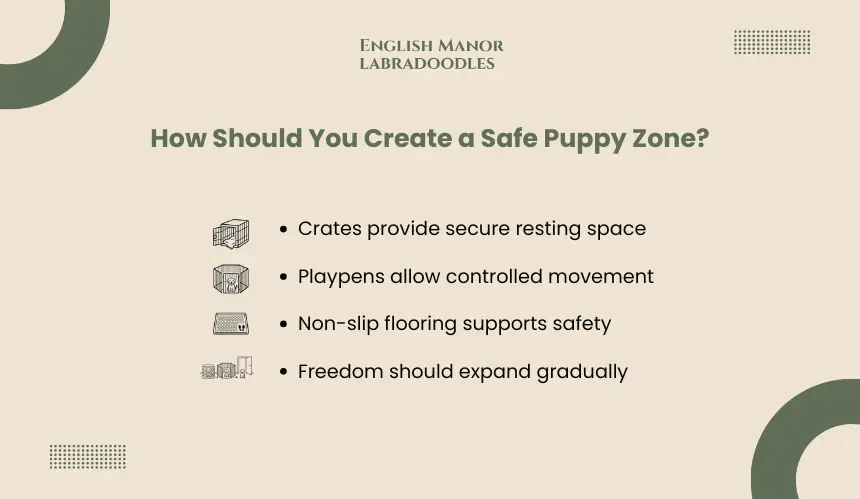
A designated puppy zone creates a controlled environment where exploration is safe and supervision is manageable. This space reduces risk during unsupervised moments and supports house training, crate conditioning, and early boundary learning.
Did You Know?
Environmental management is one of the primary strategies recommended by professional trainers to prevent reinforcement of unwanted behaviors during the first six months of life.
A properly designed puppy zone should include containment, comfort, and controlled stimulation.
Choosing Between a Crate and a Playpen
A crate provides a den-like resting area that supports bladder control and routine development. The crate should be large enough for the puppy to stand, turn around, and lie comfortably, but not so large that one corner becomes a bathroom area.
An exercise pen (playpen) provides more space for movement while maintaining safety. This is useful for active breeds like the Labradoodle, which require moderate activity even at a young age.
Many owners use both: a crate for sleep and short rest periods, and a gated play area for supervised wake time.
Proper Placement of the Safe Zone
The zone should be located in a low-traffic but socially connected area of the home. Complete isolation can increase stress, while high-traffic placement may cause overstimulation.
Avoid placing the crate near heating vents, direct sunlight, or loud appliances. Stable environmental temperature and moderate activity levels support calm adjustment.
Flooring and Bedding Considerations
Use non-slip surfaces to prevent joint strain during early growth. Bedding should be durable and washable. Avoid loose stuffing materials that could be torn and ingested.
During early teething, some puppies may chew bedding. If this occurs, temporarily use flat crate pads designed for durability.
Safe Items Within the Zone
The safe zone should contain:
- Age-appropriate chew toys
- A water bowl secured to prevent tipping
- A crate mat or bed
- No loose small objects
Toys should be size-appropriate to prevent choking. Rotating toys every few days maintains novelty without overstimulation.
Gradual Freedom Expansion
The safe zone is temporary. As the puppy demonstrates reliable behavior, such as consistent potty habits and reduced chewing, supervised access to additional areas can expand gradually.
Progression should be earned, not automatic. Labradoodles mature quickly but remain physically capable of accessing countertops and furniture earlier than many smaller breeds.
Monitoring and Supervision
Even in a secure zone, supervision remains essential. Cameras or baby monitors can help when the puppy is briefly alone. However, containment does not replace active engagement.
A well-designed puppy zone reduces stress for both owner and puppy, prevents accidental ingestion, and reinforces structure during early development.
With the interior containment addressed, outdoor safety measures must also be evaluated thoroughly.
What Does Outdoor Puppy-Proofing Involve?
Outdoor spaces present different risks than indoor environments. While a fenced yard may appear secure, gaps, toxic landscaping, standing water, and unsecured tools can create serious hazards for a young Labradoodle.
Did You Know?
Young dogs are more likely to ingest foreign materials outdoors due to natural foraging instincts inherited from their retriever lineage.
Outdoor safety requires inspection, containment, and chemical awareness.
Fence Inspection and Structural Integrity
Walk the full perimeter of the yard and inspect:
- Gaps beneath fencing
- Loose boards or weak panels
- Areas where digging could create escape routes
- Climbable structures near fences
Labradoodles are athletic and capable jumpers. Fence height should generally be sufficient to prevent climbing or jumping escape attempts. Gates must latch securely and close fully.
Removing Toxic Plants and Landscaping Hazards
Certain ornamental plants can cause gastrointestinal distress or more severe reactions if chewed. In addition to toxic plants, consider:
- Cocoa mulch (contains theobromine)
- Fertilizers and lawn treatments
- Recently applied pesticides
Consulting plant toxicity databases, such as the ASPCA, helps identify risks.
Securing Pools, Ponds, and Water Features
Water hazards require barriers or constant supervision. Puppies may fall into pools or struggle to find exit steps. Pool fences, covers, and clearly accessible exit points reduce the risk of drowning.
Even shallow decorative ponds can pose danger due to slippery edges or chemical treatments.
Inspecting Tools, Sheds, and Chemicals
Garden sheds should remain locked. Tools such as rakes, pruning shears, and extension cords must be stored safely. Gasoline, antifreeze, and lawn chemicals should be stored in sealed containers and kept inaccessible.
Antifreeze, in particular, is highly toxic even in small quantities.
Eliminating Small Object Hazards Outdoors
Stones, sticks, and discarded debris can be swallowed. Regular yard cleanup prevents ingestion-related emergencies.
Outdoor areas require ongoing inspection, especially after storms or landscaping changes.
With both indoor and outdoor safety addressed, the next step is ensuring you have the essential supplies that make puppy-proofing effective and sustainable.
What Essential Puppy-Proofing Supplies Should You Have?
Having the right equipment makes puppy-proofing faster, safer, and more sustainable. While hazard removal is the first step, certain tools reinforce boundaries and prevent repeated risk exposure, especially for an active breed like the Labradoodle.
Did You Know?
Environmental management tools, such as baby gates and playpens, are widely recommended by professional trainers to prevent unwanted behavior from becoming habitual during early development.
Must-Have Safety Items
These core supplies support indoor containment and hazard prevention:
- Baby gates to block staircases or restricted rooms
- Exercise pen (playpen) for controlled daytime movement
- Cord protectors or cable sleeves to prevent electrical chewing
- Cabinet locks for low storage areas
- Lidded or locking trash bins
- Durable, size-appropriate chew toys
Heavy-duty chew toys are especially important during the teething stage, which typically intensifies between 3 and 6 months.
Monitoring and Containment Tools
Additional tools enhance supervision and safety:
- Crate with a divider panel to adjust the space as the puppy grows
- Non-slip floor mats in high-activity areas
- Pet-safe bitter deterrent spray (used sparingly and strategically)
- ID tag and secure collar or harness
- Optional GPS tracking collar for outdoor areas
These tools do not replace supervision but significantly reduce risk.
Supplies That Support Prevention Through Engagement
Mental stimulation reduces destructive behavior. Labradoodles, due to their intelligence, require structured engagement to prevent boredom-driven chewing.
Useful items include:
- Food-dispensing toys
- Puzzle feeders
- Rotational toy sets
Providing appropriate outlets reduces the likelihood that furniture or household items will become targets.
Having the correct supplies in place simplifies enforcement of boundaries and strengthens safety measures. However, tools alone are not enough; training and supervision remain critical components of effective puppy-proofing.
How Do Training and Supervision Support Puppy-Proofing?
Puppy-proofing reduces opportunity, but training shapes behavior. Environmental control prevents accidents; structured training teaches the puppy how to behave safely within that environment. For intelligent breeds like the Labradoodle, early guidance is essential because curiosity and learning speed develop simultaneously.
Did You Know?
Behavioral patterns practiced repeatedly in the early months become significantly harder to modify later due to reinforcement cycles.
Teaching “Leave It” and Impulse Control
Introducing the “leave it” cue early helps prevent ingestion of unsafe objects. Training should begin with low-value items in controlled settings before progressing to higher levels of distraction.
Impulse control exercises, such as waiting briefly before eating or pausing at doorways, build self-regulation. Labradoodles benefit from structured boundaries that channel their energy in a productive way.
Active Supervision in Early Weeks
Even a well-secured home requires direct supervision during the first several weeks. Puppies move quickly and can discover overlooked hazards. Supervision allows immediate redirection before unsafe behavior becomes a habit.
Short tethering (leashing the puppy to the owner indoors) can help maintain proximity and prevent unsupervised wandering.
Gradual Freedom Expansion
Access to additional rooms should increase only after the puppy consistently demonstrates safe behavior. Expanding territory too quickly can expose the puppy to unmonitored risks and reinforce unwanted habits.
Controlled progression teaches the puppy that freedom is earned through reliability.
How Quickly Can You Puppy-Proof Your Home?
Puppy-proofing does not require weeks of preparation. Most homes can be made significantly safer within a few hours if the process is structured. However, thorough protection requires both immediate action and ongoing monitoring.
Did You Know?
Many preventable puppy accidents occur within the first two weeks at home, often before owners complete full safety adjustments.
What Can Be Done in 30 Minutes?
A rapid safety sweep should prioritize the highest-risk items:
- Unplug or secure exposed electrical cords
- Remove small swallowable objects from floors
- Relocate medications and cleaning products
- Secure trash bins
- Block stair access with temporary barriers
This emergency-level preparation immediately reduces ingestion and electrocution risk.
What Should Be Completed Within 24 Hours?
A more comprehensive setup includes:
- Installing baby gates
- Locking lower cabinets
- Setting up a crate or playpen
- Inspecting yard fencing
- Removing toxic indoor and outdoor plants
- Securing sheds, tools, and chemicals
This stage establishes controlled containment and prevents most predictable accidents.
Why Is Ongoing Monitoring Necessary?
Puppies grow quickly. As height and strength increase, new areas become accessible. Countertops that were previously unreachable may become targets within weeks.
Weekly inspections help identify new risks, especially during teething stages and growth spurts.
Puppy-proofing is not a one-time task, it evolves with the puppy’s development. With preparation timelines clarified, it is equally important to recognize common mistakes that can undermine safety efforts.
What Common Puppy-Proofing Mistakes Should Be Avoided?
Even well-prepared homes can become unsafe when certain mistakes are overlooked. Puppy-proofing is most effective when hazards are removed proactively and consistently — not reactively after an incident occurs.
Did You Know?
Many emergency veterinary cases involving puppies are linked to preventable household accidents rather than outdoor accidents.
Relying Only on Supervision
Supervision is essential but not foolproof. Puppies move quickly, and a brief distraction can be enough for them to grab a hazardous object. Environmental control must come first, with supervision as reinforcement, not replacement.
Assuming Small Objects Are Harmless
Items such as hair ties, socks, bottle caps, and children’s toys can cause intestinal blockage if swallowed. Labradoodles, with strong retrieving instincts, are especially prone to carrying and chewing loose items.
Delaying Outdoor Safety Checks
Owners sometimes secure indoor spaces while overlooking the yard. Unchecked fence gaps, unsecured tools, or accessible fertilizers can create immediate danger once outdoor access begins.
Using Unsafe Deterrents
Some chemical deterrent sprays or improvised solutions may irritate the puppy’s mouth or skin. Only pet-safe products should be used, and deterrents should not replace structured training.
Expanding Freedom Too Quickly
Allowing full-house access before consistent behavior is established increases the chance of destructive chewing or unsafe exploration. Access should grow gradually and be earned through reliability.
Avoiding these mistakes preserves the integrity of your puppy-proofing plan and significantly reduces risk. Next, we’ll consolidate everything into a practical checklist for quick reference.
Puppy-Proofing Checklist for a Labradoodle
A structured checklist makes puppy-proofing measurable and prevents overlooked hazards. This list can be completed within 24 hours and reviewed weekly as your puppy grows.
Did You Know?
Regular environmental reassessment is recommended during rapid growth phases, especially between 3 and 6 months when reach and strength increase significantly.
Indoor Safety
Area | Secured | Notes |
Electrical cords bundled or covered | ☐ | |
Power strips elevated or hidden | ☐ | |
Cleaning chemicals locked | ☐ | |
Medications stored out of reach | ☐ | |
Toxic houseplants removed | ☐ | |
Trash bins secured with lids | ☐ | |
Small objects cleared from floors | ☐ | |
Baby gates installed for stairs | ☐ | |
Cabinet locks installed (if needed) | ☐ | |
Crate or playpen set up properly | ☐ |
Outdoor Safety
Area | Secured | Notes |
Fence inspected for gaps | ☐ | |
Gates latch securely | ☐ | |
Toxic landscaping removed | ☐ | |
Fertilizers and chemicals are locked | ☐ | |
Tools stored safely | ☐ | |
Pools or ponds secured | ☐ |
Training & Supervision
Task | Completed | Notes |
“Leave it” introduced | ☐ | |
Chew toys available | ☐ | |
Safe zone established | ☐ | |
Supervision plan in place | ☐ | |
Weekly hazard re-check scheduled | ☐ |
Using this checklist ensures that safety is systematic rather than assumed. With preparation complete, the final step is addressing common questions about maintaining a puppy-proof home long-term.
Frequently Asked Questions
How long should I keep my home puppy-proofed?
Most homes should remain puppy-proofed for at least the first 6–12 months. Labradoodles mature physically before they mature behaviorally, meaning chewing and curiosity may continue even after teething ends. Gradual removal of safety measures should occur only once consistent reliability has been demonstrated.
Do Labradoodles chew more than other breeds?
Labradoodles are not necessarily excessive chewers, but their intelligence and retrieving instinct increase object exploration. During the 3–6 month teething phase, chewing intensifies due to gum discomfort. Providing appropriate chew toys and restricting access to unsafe items significantly reduces destructive behavior.
Is crate training part of puppy-proofing?
Crate training supports puppy-proofing by providing a secure resting area when supervision is limited. A properly introduced crate prevents access to hazards during unsupervised periods and reinforces house-training routines. It should be used as a safety tool, not as punishment.
What household items are most dangerous for puppies?
Common high-risk items include electrical cords, medications, cleaning chemicals, small swallowable objects (socks, hair ties), toxic plants, trash containing bones or packaging, and antifreeze stored in garages. Many of these items are accessible at floor level, making them easy targets.
How often should I re-check safety measures?
Safety checks should be performed weekly during the first few months and after any home rearrangement or landscaping change. As puppies grow taller and stronger, new surfaces become reachable, requiring adjustment of previously safe areas.