- englishmanor
How Do You Start Potty Training a Labradoodle Puppy in One Week?
Quick Overview: To potty train a Labradoodle puppy in one week, follow a strict routine, use crate training, and reinforce good behavior consistently. The process works through:
With consistency and quick responses, a Labradoodle puppy can begin forming reliable potty habits within one week. |
Potty training a puppy often feels unpredictable; one day, everything goes right, and the next day, accidents happen again. This inconsistency is frustrating, especially when new owners expect quick progress but don’t fully understand how puppies learn habits.
Did you know? Most puppies don’t naturally know where to go; they learn through repetition, timing, and immediate feedback, not punishment.
The real challenge isn’t teaching the puppy once—it’s creating a routine that the puppy can recognize and repeat. Labradoodles are highly intelligent, but their energy and curiosity can easily distract them, making consistency even more important during the first week.
Without a structured plan, common issues appear quickly:
- Accidents happen shortly after coming inside
- Missed potty signals
- Confusion between indoor and outdoor behavior
A one-week potty training approach works because it focuses on habit formation through repetition and timing. By controlling when the puppy eats, sleeps, and goes outside, you guide their behavior instead of reacting to mistakes.
Did you know? Puppies develop habits faster when actions are repeated at the same time every day, which is why schedule-based training is so effective.
This guide breaks down exactly how to structure those seven days, showing how routine, supervision, and reinforcement work together to build reliable potty habits from the start.
What Makes Labradoodle Puppies Easy or Difficult to Potty Train?
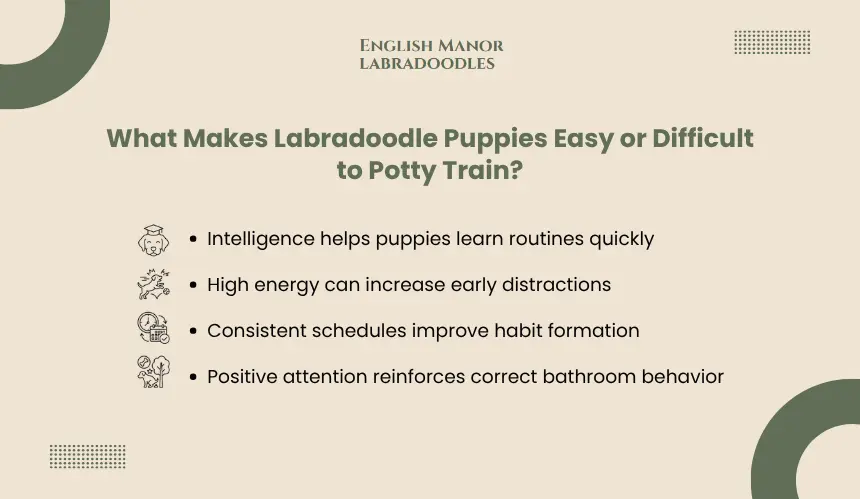
Potty training success depends heavily on how a puppy learns, responds to routines, and manages energy levels. Labradoodle puppies have traits that can both accelerate and complicate training, making it important to understand how their behavior influences progress.
How Intelligent Are Labradoodles for Training?
Labradoodles are highly intelligent due to their Labrador Retriever and Poodle lineage. This makes them quick learners who can understand patterns and commands faster than many breeds.
However, intelligence also means they:
- Pick up both good and bad habits quickly
- Require consistent reinforcement to avoid confusion
- Respond best to structured, predictable routines
Did you know? Intelligent breeds learn faster, but they also repeat mistakes faster if routines are inconsistent.
Why Does Energy Level Affect Training?
Labradoodle puppies are naturally energetic and curious. High energy levels can make them easily distracted, especially during early training stages.
This affects potty training because:
- They may forget signals when excited
- Playtime can delay bathroom breaks
- Sudden movements can lead to accidents
How Does Routine Impact Learning Speed?
Puppies rely on repetition to form habits. Labradoodles, in particular, respond strongly to consistent schedules, which help them associate specific times and actions with going outside.
A structured routine:
- Reduces confusion between indoor and outdoor behavior
- Builds predictable bathroom habits
- Speeds up learning within the first week
How Do Behavioral Traits Influence Potty Training?
Labradoodles are social and people-oriented, which means they respond well to attention and rewards. This makes positive reinforcement highly effective during training.
Did you know? Puppies are more likely to repeat behaviors that result in attention or rewards, which is why timing is critical in potty training.
What Do You Need Before Starting Potty Training?
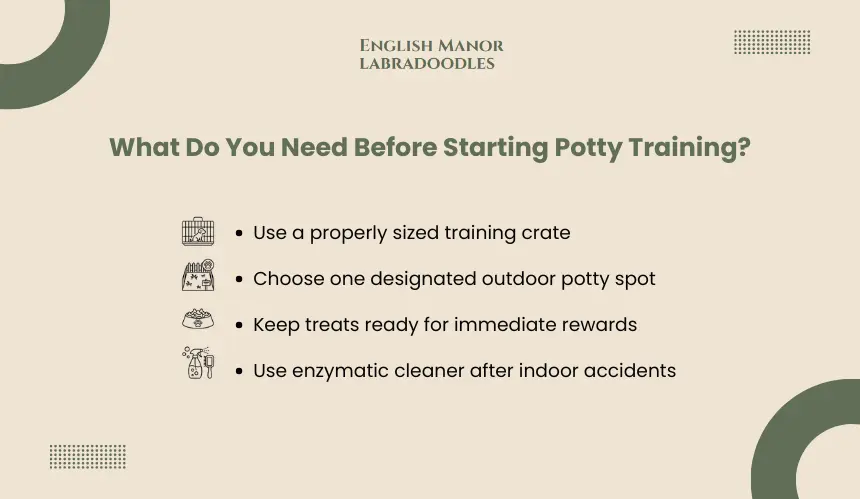
Preparation determines how quickly and smoothly potty training progresses. Without the right setup, even a well-planned routine can fail due to inconsistency or lack of control over the puppy’s environment.
What Supplies Are Required?
Having the right tools ensures that training is structured and manageable from day one. Each item plays a role in guiding behavior and preventing accidents.
Essential supplies include:
- Crate: Provides a controlled space and helps build bladder discipline
- Leash: Ensures quick and direct outdoor trips
- Designated potty spot: Creates consistency in where the puppy eliminates
- Training treats: Used for immediate positive reinforcement
- Enzymatic cleaner: Removes odor to prevent repeat accidents indoors
Did you know? Puppies are more likely to return to the same spot if they can smell previous accidents, which is why proper cleaning is critical.
How Do You Set Up a Training Area?
Limiting the puppy’s access to the home prevents unsupervised accidents. A controlled space helps you monitor behavior and respond quickly when the puppy shows signs of needing to go.
A proper setup should:
- Restrict movement to a small, easy-to-monitor area
- Keep the crate nearby for quick access
- Provide a clear path to the outdoor potty location
Why Is Consistency Important from Day One?
Puppies learn through repetition, not explanation. If feeding times, potty breaks, and rewards are inconsistent, the puppy cannot form a clear behavioral pattern.
Consistency ensures:
- Faster habit formation
- Reduced confusion between indoor and outdoor behavior
- Fewer training setbacks
How Does Preparation Prevent Early Mistakes?
Most training issues occur because the environment allows too much freedom too soon. Proper preparation reduces the chances of missed signals, delayed responses, and preventable accidents.
Did you know? Early-stage mistakes often become habits if not corrected quickly, which is why structured preparation is essential.
What Is the 7-Day Potty Training Plan for a Labradoodle Puppy?

A one-week potty training plan works by creating a highly repetitive routine that teaches the puppy exactly when and where to go. Each phase builds on the previous one, moving from observation to habit formation and finally to consistency.
Day 1–2: Establishing Routine and Observatio
The first two days focus on building awareness and controlling the puppy’s environment. At this stage, your goal is not perfection but pattern recognition.
Key actions:
- Take the puppy outside every 1–2 hours
- Always go after eating, drinking, sleeping, or playtime
- Use the same outdoor spot every time
- Watch closely for signals like sniffing or circling
Reward immediately after successful potty outside.
Did you know? The first 48 hours are critical for setting expectations, as puppies begin associating specific locations with bathroom behavior.
Day 3–4: Reinforcing Outdoor Habits
By this stage, the puppy has begun to recognize the routine. Now the focus shifts to strengthening the association between going outside and receiving rewards.
Key actions:
- Continue the strict schedule without skipping trips
- Increase supervision indoors to prevent accidents
- Begin guiding the puppy to the door before taking them out
- Reward faster and more consistently after success
At this stage, accidents may still happen, but they should begin to decrease.
Day 5–7: Reducing Accidents and Building Consistency
The final phase focuses on reinforcing habits and improving reliability. The puppy should begin to show clearer signals and better control.
Key actions:
- Slightly extend the time between potty breaks if progress is consistent
- Encourage the puppy to signal (e.g., waiting by the door)
- Maintain immediate rewards for correct behavior
- Continue crate use to prevent unsupervised accidents
Did you know? By the end of one week, most puppies won’t be fully trained but will have a clear understanding of where and when to go.
How Does This Plan Build Habits Quickly?
The effectiveness of a 7-day plan comes from repetition and timing. By controlling when the puppy eats, sleeps, and goes outside, you eliminate guesswork and create predictable behavior patterns.
What Should You Expect After One Week?
After seven days, your Labradoodle puppy should:
- Have fewer indoor accidents
- Begin signaling when they need to go
- Understand that outdoor spaces are the correct place
How Does a Potty Training Schedule Improve Success?
A potty training schedule removes guesswork by aligning the puppy’s natural biological patterns with consistent outdoor opportunities. Instead of waiting for accidents to happen, the schedule anticipates when the puppy needs to go and guides behavior proactively.
When Should You Take Your Puppy Outside?
Timing is the most important factor in potty training. Puppies have predictable triggers that signal the need to eliminate, and missing these windows often leads to accidents.
Always take your puppy outside:
- Immediately after waking up
- After eating or drinking
- After play sessions
- Before bedtime
Did you know? Puppies often need to go within 5–15 minutes after eating, making post-meal trips one of the most important training moments.
How Often Should Breaks Happen?
Young Labradoodle puppies have limited bladder control, so frequent breaks are necessary during the first week. Waiting too long increases the likelihood of accidents.
General guideline:
- Every 1–2 hours during the day
- More frequently for younger puppies
- Adjust based on observed behavior and progress
Why Do Feeding Times Matter?
A consistent feeding schedule regulates digestion, which directly affects when the puppy needs to go. Irregular feeding leads to unpredictable bathroom timing, making training more difficult
How Does Scheduling Prevent Accidents?
By taking the puppy out at the right times, you reduce the chance of indoor mistakes. The puppy learns that bathroom breaks happen in a specific place and at predictable intervals.
Did you know? Consistency in timing helps puppies develop internal cues, making it easier for them to hold and signal when they need to go.
How Does a Schedule Build Long-Term Habits?
Repetition at fixed times creates strong behavioral patterns. Over time, the puppy begins to anticipate bathroom breaks and adjust its behavior accordingly.
How Does Crate Training Help Potty Training?
Crate training supports potty training by creating a controlled environment where the puppy learns to hold its bladder and associate outdoor spaces with elimination. It works by using the puppy’s natural instinct to keep its sleeping area clean.
Why Do Puppies Avoid Soiling Their Crate?
Puppies naturally avoid eliminating in the space where they rest. When a crate is properly sized, large enough to stand and turn, but not so large that it separates the sleeping and bathroom areas, it encourages the puppy to wait until they are taken outside.
Did you know? This instinct is one of the most effective behavioral tools in potty training because it promotes bladder control without force or punishment.
How Long Should a Puppy Stay in a Crate?
Crate time should be based on the puppy’s age and bladder capacity. Young puppies cannot hold their bladder for long periods, so extended confinement can lead to accidents and slow progress.
A general approach is to:
- Use short crate intervals during the day
- Always take the puppy outside immediately after release
- Avoid leaving the puppy crated longer than it can physically manage
How Do You Use Crates Correctly?
The crate should be used as a training tool, not as a place of punishment. It helps structure the puppy’s routine by alternating between supervised freedom, crate time, and outdoor breaks.
Correct use involves:
- Taking the puppy out on a consistent schedule
- Reinforcing outdoor success immediately
- Returning the puppy to the crate when supervision is not possible
How Does Crate Training Prevent Accidents?
By limiting unsupervised movement, the crate reduces the puppy’s opportunities to have indoor accidents. It ensures that bathroom breaks happen under controlled conditions, where you can guide behavior and reinforce the correct habit.
Did you know? Most indoor accidents occur when puppies are left unsupervised, which is why controlled environments are essential during early training.
How Do You Use Positive Reinforcement Effectively?
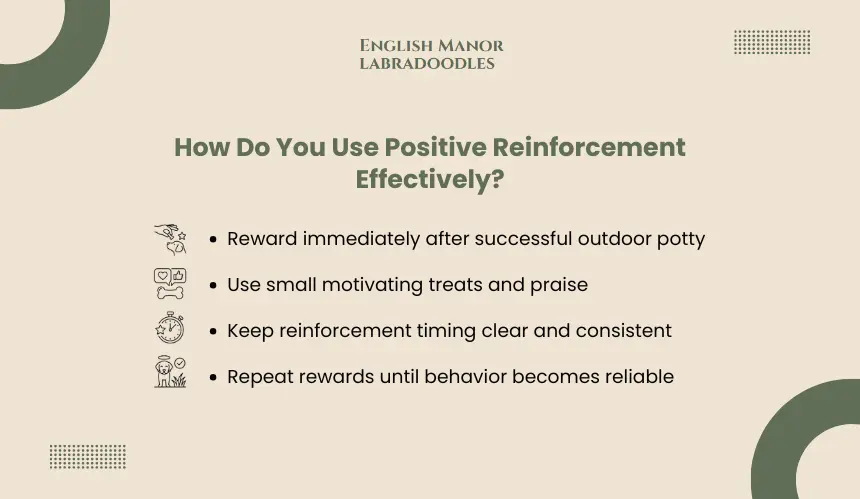
Positive reinforcement is the most effective way to teach a Labradoodle puppy where to potty because it strengthens the connection between the correct behavior and a reward. Puppies repeat actions that lead to immediate positive outcomes, making timing and consistency essential.
What Rewards Work Best?
Rewards should be highly motivating and easy to deliver instantly. Small, soft treats are effective because they can be given quickly without interrupting the moment. Verbal praise and an enthusiastic tone also reinforce the behavior, especially for Labradoodles, which respond well to attention.
Did you know? The value of the reward matters; puppies are more likely to repeat behaviors that lead to something they find exciting or rewarding.
When Should You Reward Behavior?
The reward must be given immediately after the puppy finishes pottying outside. Any delay weakens the connection between the action and the reward, making it harder for the puppy to understand what it did correctly.
Why Is Timing Critical in Reinforcement?
Puppies associate rewards with the last action they performed. If the reward comes too late, they may link it to a different behavior, such as walking back inside or sitting, rather than the act of pottying.
How Does Reinforcement Build Reliable Habits?
Repeatedly rewarding the correct behavior creates a clear pattern. The puppy begins to associate going outside with a positive outcome, increasing the likelihood of consistently choosing that behavior.
Did you know? Consistency in reinforcement is what turns a learned action into a habit, especially during the early stages of training.
How Do You Recognize Potty Signals in a Labradoodle Puppy?
Recognizing early potty signals allows you to act before an accident happens. Puppies rarely eliminate without warning; most display subtle behavioral changes that indicate they need to go. Identifying these signals quickly is key to reinforcing the correct habit.
Common Signs Your Puppy Needs to Go
Labradoodle puppies often show consistent pre-potty behaviors. These signals may appear suddenly and require immediate attention.
Typical signs include:
- Sniffing the ground repeatedly
- Circling or pacing in one area
- Suddenly stopping play or becoming restless
- Moving toward corners or away from activity
Did you know? Sniffing is one of the earliest indicators because puppies instinctively search for a suitable spot before eliminating.
How Do You Respond Quickly?
The moment you notice a signal, take the puppy outside immediately. Any delay increases the chance of an accident and weakens the association between the signal and the correct location.
Quick response ensures:
- The puppy completes the action in the right place
- You can reward the behavior instantly
- The signal becomes part of a learned routine
Why Does Early Recognition Reduce Accidents?
Catching the behavior before it turns into an accident allows you to guide the puppy toward the correct outcome. Over time, the puppy learns that signaling leads to being taken outside, reinforcing communication.
How Do Signals Become Consistent Over Time?
As training progresses, these signals become more noticeable and predictable. The puppy begins to rely on them as a means of communication, especially when consistently rewarded for correct behavior.
Did you know? Puppies that are consistently guided when signaling learn faster because they associate their behavior with a clear and reliable response.
What Are the Most Common Potty Training Mistakes?
Mistakes during potty training usually stem from inconsistency, delayed responses, or misunderstandings about puppy behavior. These errors confuse the puppy and slow down habit formation, even if the training method itself is correct.
Why Does an Inconsistent Schedule Slow Progress?
When potty breaks, feeding times, and routines vary, the puppy cannot predict when or where to go. This lack of pattern makes it harder to build reliable habits, leading to more accidents indoors.
Did you know? Puppies learn fastest when routines are repeated at the same time every day, because predictability strengthens behavioral patterns.
How Do Delayed Rewards Create Confusion?
If the reward is not given immediately after the puppy finishes pottying outside, the puppy may associate it with a different action. This weakens the connection between the correct behavior and the reward, reducing learning efficiency.
Why Does Punishing Accidents Make Training Worse?
Punishment does not teach the correct behavior; it only creates fear or hesitation. Puppies may start hiding accidents rather than learning where to go, making training more difficult.
How Does Too Much Freedom Lead to Accidents?
Allowing the puppy to roam unsupervised increases the chances of missed signals and unnoticed accidents. Without supervision, there is no opportunity to guide the puppy to the correct location.
Why Is Ignoring Signals a Critical Mistake?
When early potty signals are missed, the puppy is forced to eliminate indoors. Repeated missed signals prevent the puppy from learning how to communicate effectively.
Did you know? Successful potty training depends as much on the owner’s timing and observation as it does on the puppy’s behavior.
How Do You Handle Accidents Without Slowing Progress?
Accidents are a normal part of potty training, especially in the first week. The goal is not to eliminate accidents immediately but to respond in a way that prevents confusion and reinforces the correct behavior moving forward.
What Should You Do Immediately After an Accident?
If you catch the puppy in the act, interrupt gently and take it outside right away. This helps redirect the behavior to the correct location without creating fear.
If the accident has already happened, clean it thoroughly and move on without reacting emotionally.
Did you know? Puppies associate reactions with actions in the moment, so delayed responses do not teach them what went wrong.
Why Should You Avoid Punishment?
Punishing a puppy for accidents can create anxiety and confusion. Instead of learning where to go, the puppy may learn to hide when it needs to eliminate, which slows progress and makes training more difficult.
How Does Proper Cleaning Prevent Repeat Accidents?
Odor plays a major role in where puppies choose to go. If a scent remains, the puppy may return to the same spot.
Using an enzymatic cleaner removes:
- Odor traces that attract repeat behavior
- Residual markers that signal a “bathroom area”
How Do You Reinforce Correct Behavior Instead?
Focus on increasing successful outdoor experiences. Every time the puppy eliminates outside and is rewarded immediately, the correct habit becomes stronger.
How Do Accidents Fit Into the Learning Process?
Accidents are feedback, not failure. They usually indicate missed signals, delayed timing, or too much freedom. Adjusting these factors improves results without disrupting progress.
Did you know? Reducing accidents is less about reacting to them and more about preventing them through better timing and supervision.
Frequently Asked Questions
Can a Labradoodle puppy really be potty trained in one week?
A Labradoodle puppy can learn the basics of potty training within one week, including recognizing routines and going outside more consistently. However, full reliability takes several weeks of continued reinforcement and consistency.
How often should I take my Labradoodle puppy outside?
During the first week, take your puppy outside every 1–2 hours and after key triggers like eating, sleeping, and playtime. Frequent breaks help prevent accidents and reinforce the correct habit quickly.
What is the fastest way to potty train a Labradoodle puppy?
The fastest approach combines a strict schedule, crate training, constant supervision, and immediate rewards. Consistency and timing are more important than any single method when aiming for quick results.
Should I use puppy pads during potty training?
Using puppy pads can create confusion by teaching the puppy that indoor elimination is acceptable. For faster outdoor training, it is better to focus on consistent trips outside and clear reinforcement.
How do I know if my puppy is learning potty training?
Signs of progress include fewer indoor accidents, more frequent outdoor success, and visible signals such as going to the door or showing restlessness before needing to go.
What should I do if my Labradoodle keeps having accidents?
Frequent accidents usually indicate inconsistent scheduling, missed signals, or too much freedom. Adjusting timing, increasing supervision, and reinforcing success outdoors will help address the issue.