- englishmanor
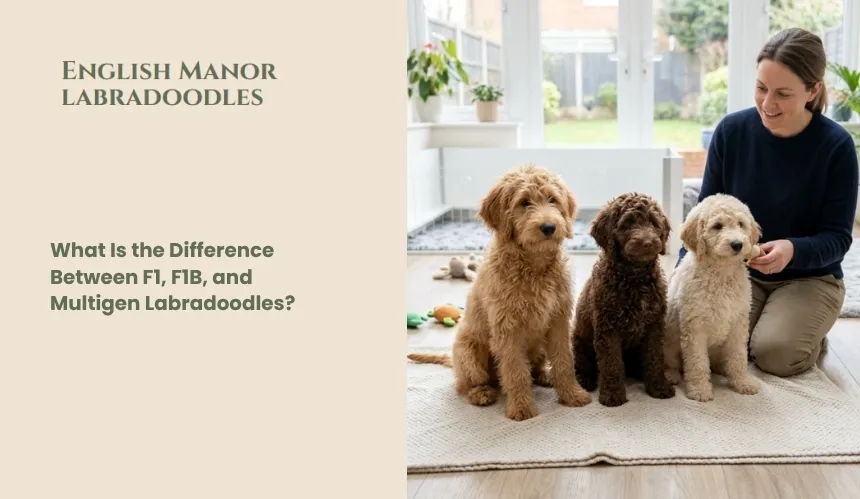
What Is the Difference Between F1, F1B, and Multigen Labradoodles?
|
Quick Overview: F1, F1B, and multigen Labradoodles differ based on genetic structure, not quality or guarantees.
|
Labradoodle generations are often discussed as if they define exactly what a puppy will become. Terms like F1, F1B, and multigen are frequently used in breeder listings, yet many buyers are left unsure of what those labels actually mean, or how much weight they should carry when choosing a puppy.
In reality, these generational terms describe how genetics are structured, not how a Labradoodle will behave, shed, or mature with certainty. Understanding the differences between F1, F1B, and multigen Labradoodles helps buyers move past marketing language and interpret breeder claims with clarity. When viewed correctly, generation labels become tools for setting expectations rather than promises about outcomes.
What Do Labradoodle Generations Actually Mean?
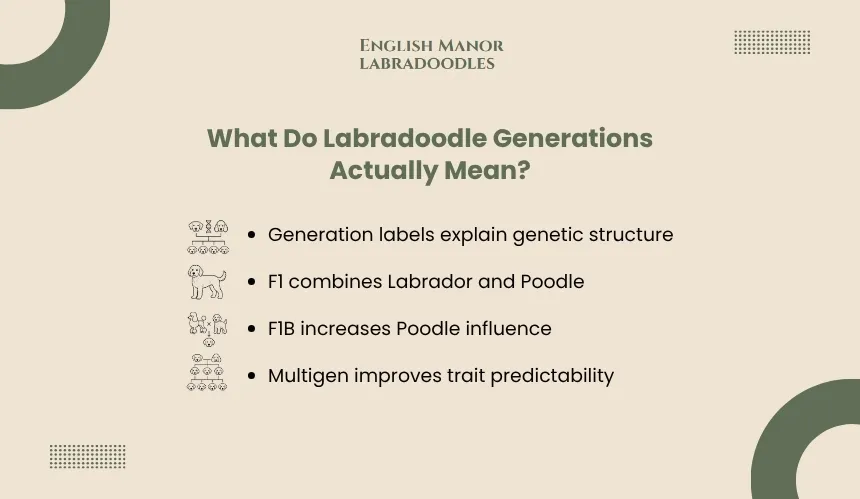
Labradoodle generations describe how a puppy’s genetics are structured, not how it will turn out with certainty. These labels explain which dogs were bred together, how much genetic variation is introduced, and how predictable outcomes are likely to be. They do not measure quality, health, or ethics on their own.
Understanding generational terms helps buyers interpret breeder descriptions accurately and avoid assuming that one label automatically delivers specific traits.
What Does “F1” Mean in Labradoodle Breeding?
An F1 Labradoodle is a first-generation cross between a purebred Labrador Retriever and a purebred Poodle. Because two distinct gene pools are combined for the first time, F1 puppies inherit a wide mix of traits.
From a genetic standpoint, F1 Labradoodles tend to show:
- The broadest range of coat textures
- The widest variation in shedding patterns
- Diverse energy levels and behavioral tendencies
Important note: This variability is a natural outcome of first-generation mixing, not a flaw. It simply means outcomes are harder to predict compared to later generations.
What Does “F1B” Mean and Why Is It Called a Backcross?
An F1B Labradoodle is produced by breeding an F1 Labradoodle back to a Poodle. This process is known as a backcross because it increases the influence of one parent breed.
Genetically, F1B Labradoodles typically have:
- A higher proportion of Poodle genetics
- Greater likelihood of curlier or wavier coats
- Reduced probability of heavy shedding, though not elimination
Did you know?
Backcrossing is commonly used in animal breeding to emphasize specific traits, but it still produces variation because multiple genes control coat and behavior.
What Does “Multigen” Mean in Labradoodle Lineage?
Multigen Labradoodles are bred from Labradoodles across multiple generations, rather than directly from purebred parents. Over time, breeders may select dogs with similar coat types, temperaments, and size ranges.
When lineage is consistent, multigen Labradoodles often show:
- Narrower coat variation across litters
- More consistent behavioral patterns
- Improved predictability in adult size and energy level
Key insight: Multigen does not mean “perfect.” Predictability improves only when breeders apply intentional selection across generations, not simply by repeating the label.
How Does Each Generation Affect Genetics and Predictability?
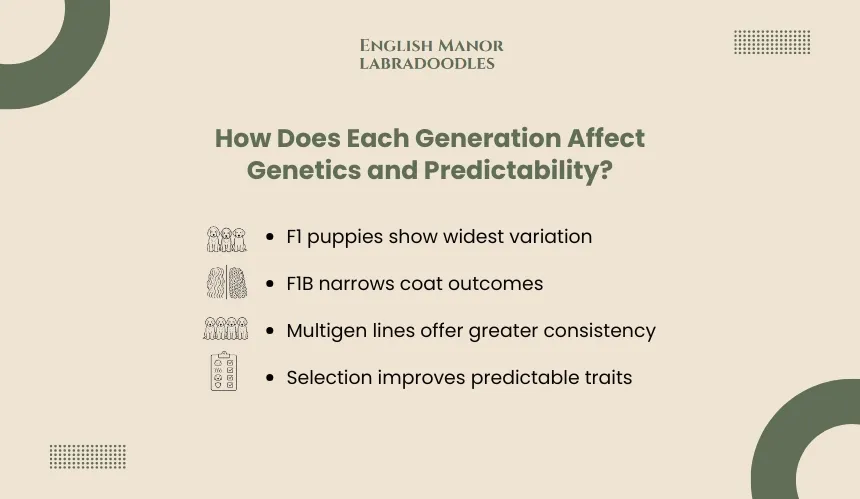
Once generational labels are clear, the next step is understanding how those structures influence genetic outcomes. Predictability is not about eliminating variation; it’s about narrowing the range of likely traits. Each generation changes how genes combine and how consistently certain characteristics appear.
Why F1 Labradoodles Show the Widest Variation
F1 Labradoodles combine two unrelated gene pools for the first time. With no prior selection to stabilize traits, genes assort independently across the litter, producing the broadest range of outcomes.
What this means in practice:
- Coat texture can range from straight to curly within the same litter
- Shedding patterns are less predictable
- Energy level and sensitivity may vary noticeably between siblings
Important note: This variability reflects genetic diversity, not poor breeding. It becomes problematic only when certainty is promised where genetics cannot support it.
How F1B Labradoodles Narrow Coat and Shedding Outcomes
Backcrossing an F1 Labradoodle to a Poodle increases the likelihood that Poodle-associated coat traits will be expressed. While behavior and size can still vary, coat-related outcomes tend to fall within a narrower range.
Typical genetic effects include:
- Higher probability of wavy or curly coats
- Reduced likelihood of heavy shedding
- Moderate improvement in predictability compared to F1 crosses
Did you know?
Because coat traits are polygenic, even backcrossed litters can produce puppies with differing textures and grooming needs.
Why Multigen Labradoodles Offer Greater Consistency
Multigen Labradoodles benefit from selection across generations. When breeders repeatedly pair dogs with similar traits, those traits become more likely to appear together in future litters.
This results in:
- More consistent coat texture across puppies
- Narrower energy and temperament ranges
- Fewer extreme outcomes when lineage is stable
Key genetic insight: Predictability increases through repeated selection, not through generational labels alone. Without consistent criteria, even multigen breeding can produce unexpected variation.
How Do Coat Type and Shedding Differ Across Generations?
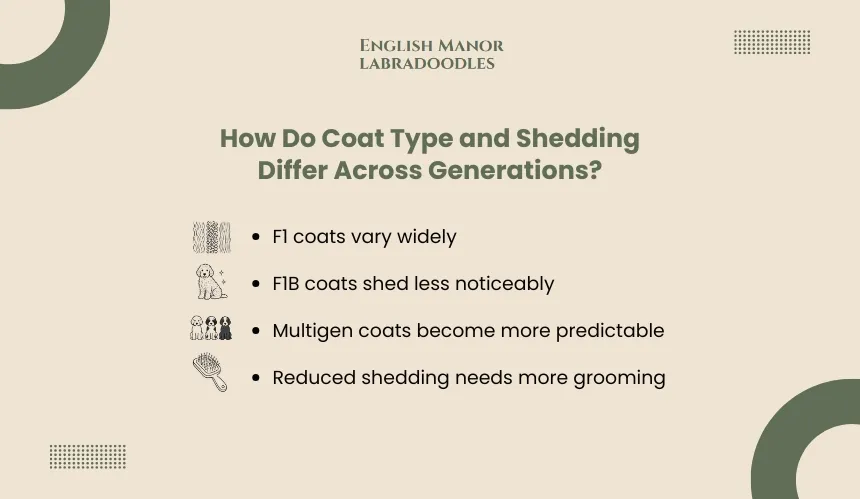
Coat type and shedding are the most discussed, and most misunderstood, differences between F1, F1B, and multigen Labradoodles. These traits are influenced by multiple interacting genes, which is why outcomes vary by generation but are never absolute.
What Coat Outcomes Are Common in F1 Labradoodles?
F1 Labradoodles can develop a wide range of coat textures because they inherit an equal mix of Labrador and Poodle coat genes. As adult coats emerge, textures often shift from early puppy appearance.
Common outcomes include:
- Straight or slightly wavy coats with seasonal shedding
- Wavy coats with moderate shedding
- Coats that change noticeably between puppyhood and adolescence
Important note:
Early fluffiness does not predict adult coat type. Adult coat development typically becomes clearer after the first year.
How F1B Breeding Influences Coat Texture and Shedding
F1B Labradoodles inherit a higher proportion of Poodle coat genetics, which increases the likelihood of curl and reduced shedding. However, reduced shedding does not mean the absence of shedding.
Typical tendencies include:
- Wavy to curly coats becoming more common
- Hair loss that is less noticeable but still present
- Higher grooming and maintenance needs
Did you know?
Dogs with reduced shedding often require more frequent grooming, as loose hair remains trapped in the coat rather than falling out naturally.
Why Multigen Coats Are More Predictable but Not Guaranteed
Multigen Labradoodles tend to show more consistent coat patterns when breeders select for similar textures across generations. This narrows variation but does not eliminate it.
What buyers can reasonably expect:
- Fewer extreme coat differences within the same litter
- More predictable grooming routines
- Lower likelihood of dramatic coat changes after maturity
Key insight: No Labradoodle generation is genetically “non-shedding.” Ethical breeders describe coat outcomes in terms of likelihood and maintenance requirements, not absolutes.
How Does Generation Influence Temperament?
Generation labels influence predictability, not personality itself. Temperament emerges from a combination of inherited tendencies, selective breeding decisions, and development over time. Understanding this distinction helps buyers avoid assuming that one generation guarantees a specific behavior style.
Why Temperament Is Not Tied to Generation Alone
F1, F1B, and multigen Labradoodles can all develop stable, adaptable temperaments. Generation describes genetic structure, but it does not assign behavioral traits in isolation. Puppies within the same generation can still differ in confidence, sensitivity, and energy.
Important note: Temperament should be discussed in patterns and ranges, not promises linked to a generation label.
How Lineage Selection Matters More Than Generation Labels
Predictability improves when breeders consistently select parent dogs with similar behavioral traits across litters. Over time, this selection narrows extremes and produces more reliable temperament trends, regardless of whether the dogs are F1, F1B, or multigen.
Did you know?
Behavioral research suggests that intentional temperament selection across generations improves consistency more than genetic structure alone, which is why lineage quality often matters more than the label itself.
Why Environment Still Shapes Behavior
Genetics establish baseline tendencies, but environment influences how those tendencies are expressed. Training, routine, social exposure, and handling all play a role in shaping adult behavior.
Key insight: Genetics load the framework; environment determines how that framework is built upon. Ethical breeding paired with appropriate upbringing leads to the most balanced outcomes.
What Are the Strengths and Limitations of Each Generation?
Each Labradoodle generation offers different advantages, depending on how much predictability a buyer wants and how flexible they are with outcomes. No generation is universally better; each comes with trade-offs that should be understood before making a decision.
When F1 Labradoodles May Be a Good Fit
F1 Labradoodles often suit buyers who are comfortable with variation and open to a wider range of coat and temperament outcomes. Because genetic diversity is highest at this stage, F1 dogs can display balanced hybrid traits but with less consistency across litters.
This generation may work well for households that:
- Are flexible about grooming and shedding expectations
- Value adaptability over predictability
- Are prepared to adjust routines as the dog matures
When F1B Labradoodles May Be a Better Choice
F1B Labradoodles are often chosen by buyers who prioritize coat management and want a higher likelihood of reduced shedding. While temperament still varies, coat-related outcomes tend to fall within a narrower range.
This option can be a practical fit for:
- Owners with allergy considerations
- Buyers willing to commit to regular grooming
- Households seeking moderate predictability without strict guarantees
When Multigen Labradoodles Make Sense
Multigen Labradoodles are typically preferred by buyers who value routine and consistency. When lineage is stable and breeding decisions are intentional, this generation offers the most reliable patterns in coat type, energy level, and temperament.
Did you know?
Selective breeding data shows that consistency in both behavior and physical traits increases measurably after several generations of focused selection, which explains why well-established multigen lines are easier to evaluate.
Multigen Labradoodles may suit:
- Families seeking predictable daily routines
- First-time dog owners wanting clearer expectations
- Buyers who value long-term stability over novelty
Understanding these strengths and limitations helps buyers choose a generation that aligns with their lifestyle rather than assuming one label automatically delivers ideal results.
Comparison Table: F1 vs F1B vs Multigen Labradoodles
Use this table to understand how genetic structure influences likelihood and predictability, not guarantees. Individual puppies may vary, but these patterns reflect how generations typically differ.
|
Factor |
F1 Labradoodle |
F1B Labradoodle |
Multigen Labradoodle |
|
Genetic Makeup |
50% Labrador × 50% Poodle |
Typically 75% Poodle × 25% Labrador |
Labradoodle × Labradoodle (multiple generations) |
|
Genetic Predictability |
Low to moderate |
Moderate |
Higher due to repeated trait selection |
|
Coat Type Range |
Straight, wavy, or curly |
Mostly wavy to curly |
More consistent (wavy or curly) |
|
Shedding Likelihood |
Variable, often seasonal |
Reduced likelihood, not eliminated |
More predictable, still not zero |
|
Coat Change Over Time |
High likelihood of change |
Moderate likelihood of change |
Lower likelihood, still possible |
|
Temperament Consistency |
Wide variation |
Moderate consistency |
Greater consistency when lineage is stable |
|
Energy Level Range |
Broad range |
Moderate range |
Narrower range when selectively bred |
|
Grooming Commitment |
Variable |
High |
High but more predictable |
|
Best Fit For |
Flexible owners open to variability |
Owners prioritizing coat management |
Owners seeking routine and predictability |
|
Common Misconception |
“Too unpredictable to manage” |
“Guaranteed non-shedding” |
“Perfect or uniform” |
How Buyers Should Use This Table
- Generation labels describe structure, not quality
- Predictability increases with lineage consistency, not just generation
- No generation eliminates shedding, grooming, or training needs
- Breeder practices matter more than labels alone
Did you know?
Canine genetics research shows that trait consistency improves gradually across generations only when breeders intentionally select for those traits, which is why multigen Labradoodles are more predictable only when lineage is well-managed.
What Common Misconceptions Exist About Labradoodle Generations?
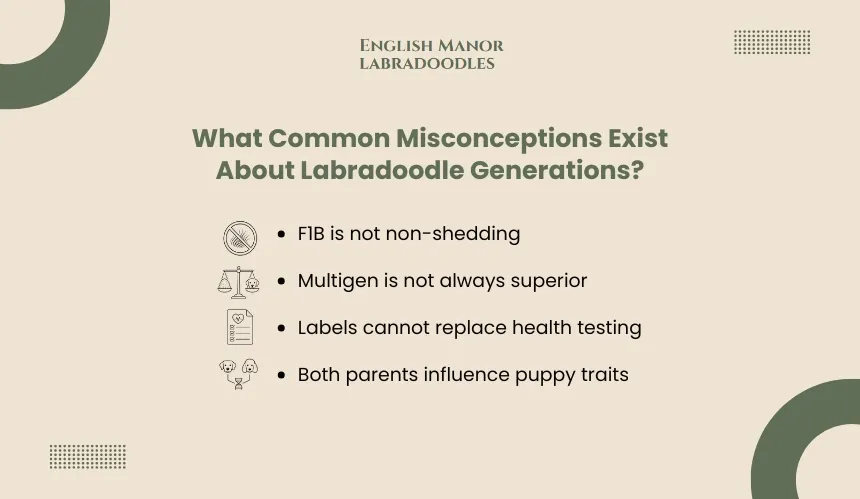
Generational labels are often treated as shortcuts for predicting outcomes, which leads to misunderstandings. Clarifying these misconceptions helps buyers evaluate breeders more accurately and avoid expectations that genetics cannot reliably meet.
Does F1B Automatically Mean Non-Shedding?
No. F1B Labradoodles are more likely to have reduced shedding due to increased Poodle genetics, but shedding is influenced by multiple genes related to hair growth cycles. Some F1B dogs still shed, while others shed minimally.
Important note:
Reduced shedding often comes with higher grooming needs, as loose hair remains trapped in the coat rather than falling out.
Is Multigen Always Superior to F1 or F1B?
Multigen Labradoodles are not inherently better. Greater predictability is possible only when lineage is stable and breeding decisions are consistent. Without intentional selection, multigen breeding can still produce wide variation.
Key insight: Lineage quality and breeder practices matter more than the generation label itself.
Can Generation Labels Replace Health Testing and Ethics?
No generation label compensates for missing health clearances, poor breeding practices, or lack of transparency. Genetics describe structure, not standards.
Did you know? Canine welfare evaluations consistently show that health testing and responsible selection have a stronger impact on long-term outcomes than generation alone.
Does One Parent’s Breed Dominate All Traits?
Traits are inherited from both parents, and different puppies express different combinations. Even when one parent shows strong desirable traits, those traits may not appear uniformly across the litter.
Understanding these misconceptions helps buyers use generation labels as context rather than conclusions, leading to more informed and realistic decision-making.
Frequently Asked Questions
Are F1 Labradoodles healthier than F1B or multigen Labradoodles?
Generation alone does not determine health. Long-term health depends on parent health testing, responsible breeding decisions, and lineage quality, not whether a Labradoodle is F1, F1B, or multigen.
Do F1B Labradoodles shed less than F1 Labradoodles?
F1B Labradoodles are more likely to have reduced shedding due to increased Poodle genetics, but shedding is never eliminated. Individual outcomes still vary because coat traits are polygenic.
Are multigen Labradoodles more predictable in temperament?
Multigen Labradoodles can be more predictable when breeders consistently select for temperament across generations. Predictability comes from lineage stability and selection, not the multigen label by itself.
Can breeders accurately predict coat type at birth?
Coat type cannot be confirmed at birth. Adult coat texture and shedding potential often change as the puppy matures, which is why ethical breeders describe outcomes in terms of likelihood rather than certainty.
Is one Labradoodle generation better for first-time dog owners?
No single generation is best for everyone. First-time owners often benefit from predictability and support, which may come from well-established multigen lines, but breeder practices and guidance matter more than generation alone.
Should buyers choose a Labradoodle based only on generation labels?
Generation labels should be used as context, not decision-makers. Buyers should also evaluate health testing, lineage consistency, temperament patterns, and breeder transparency before choosing a puppy.