
- englishmanor
What Is the Best Age to Bring a Labradoodle Puppy Home?
| Quick Overview: The best age to bring a Labradoodle puppy home is typically between 8 and 10 weeks old. At this stage, puppies have completed early social learning with their littermates, begun weaning, and developed foundational bite-inhibition skills. They are emotionally ready to bond with a new family while remaining young enough to adapt quickly to training, routines, and household environments. |
Bringing home a Labradoodle puppy is an exciting milestone, but the timing of that transition can significantly influence long-term behavior, confidence, and trainability. While it may be tempting to take a puppy home as soon as possible, early separation can interrupt critical stages of canine development.
Did You Know?
Puppies experience a primary socialization window between 3 and 12 weeks of age. During this period, their brains are highly receptive to learning social cues, environmental confidence, and bite control from their mother and littermates.
Leaving a puppy with the breeder for the appropriate amount of time allows it to complete essential milestones such as weaning, early social interaction, and emotional regulation. Bringing a puppy home too early can increase the risk of separation anxiety, poor bite inhibition, and fear-based behaviors later in life.
Understanding developmental timing is key to making an informed decision. To determine the ideal age, it’s important to look closely at what happens during the first weeks of a puppy’s life.
Why Does Age Matter When Bringing a Puppy Home?
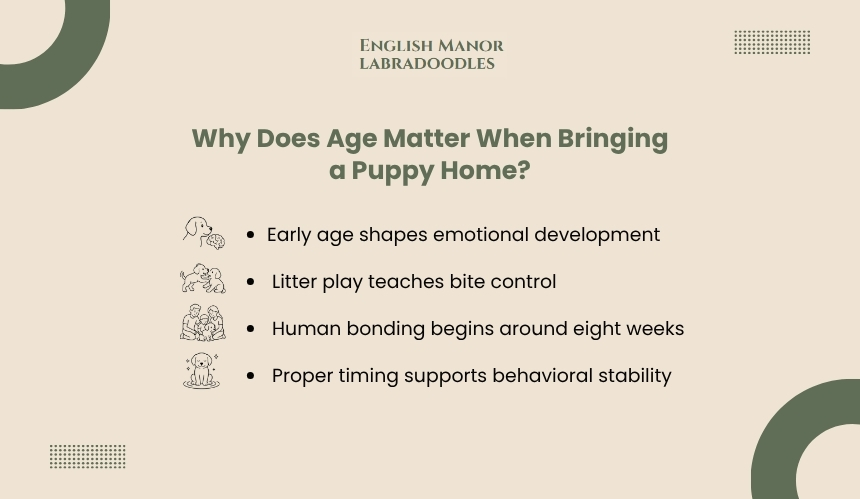
Age directly affects a puppy’s emotional development, social skills, and long-term behavioral stability. During the first weeks of life, puppies progress through clearly defined neurological and social stages that shape how they respond to people, environments, and stress later in life.
Did You Know?
Studies in canine behavioral development show that puppies separated from their litter before 8 weeks are more likely to display increased fearfulness, excessive barking, and difficulty with impulse control as adults.
What Happens During Weeks 0–3?
The first three weeks are known as the neonatal period. Puppies are completely dependent on their mother for warmth, nutrition, and stimulation. Their eyes and ears gradually open, but mobility and awareness remain limited. Removing a puppy at this stage disrupts the development of basic survival skills.
What Happens During Weeks 3–8?
Between three and eight weeks of age, puppies enter a rapid social learning phase. They begin interacting with littermates, practicing bite inhibition, and learning boundaries through play. When a puppy bites too hard, littermates yelp and withdraw, teaching self-control.
This period is critical for:
- Social confidence
- Emotional regulation
- Communication signals
- Frustration tolerance
Separating a puppy before this stage is complete can interrupt these lessons.
What Changes Between 8–12 Weeks?
By 8 weeks, most puppies have been fully weaned and are neurologically ready to form strong attachments to humans. They are highly adaptable and can learn household routines, crate training, and early obedience.
This stage balances two key advantages:
The puppy has gained social stability from the litter, but remains young enough to bond deeply with a new family.
Understanding these developmental stages clarifies why most experts recommend waiting until at least 8 weeks before bringing a puppy home.
Why Do Most Breeders Recommend 8 Weeks?
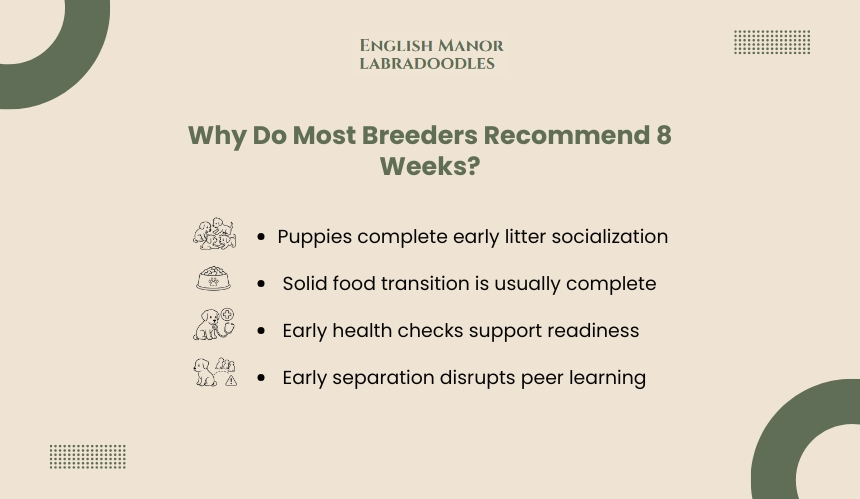
Most responsible breeders recommend releasing puppies at 8 weeks because this timing aligns with both developmental readiness and ethical breeding standards. By this age, puppies have completed early litter socialization while remaining adaptable enough to transition smoothly into a new home.
Did You Know?
Many U.S. states legally prohibit the sale or transfer of puppies before 8 weeks of age due to behavioral and welfare concerns.
What Developmental Milestones Are Completed by 8 Weeks?
By the eighth week, a puppy has typically:
- Fully transitioned from nursing to solid food
- Developed basic bite inhibition through litter play
- Begun responding to human handling
- Reached a stage of emotional resilience
- Completed initial deworming protocols
This balance of social maturity and adaptability makes 8 weeks a widely accepted standard among veterinarians and ethical breeders.
What About Health and Vaccinations?
Before going home, puppies usually receive:
- A veterinary health check
- First round of core vaccinations (often at 6–8 weeks)
- Initial deworming treatments
While the vaccination series is not yet complete, puppies at 8 weeks are medically stable enough to transition with continued veterinary follow-up.
Why Not Earlier?
Removing a puppy before 8 weeks of age disrupts peer learning and maternal correction. Puppies need this time to refine social signals, manage frustration, and develop bite-pressure control, lessons that are difficult to fully replicate in a human-only environment.
Although 8 weeks is standard, some breeders and families consider waiting slightly longer. Understanding whether 10–12 weeks offers additional benefits requires a closer look at extended breeder care.
Is 10–12 Weeks Better Than 8 Weeks?
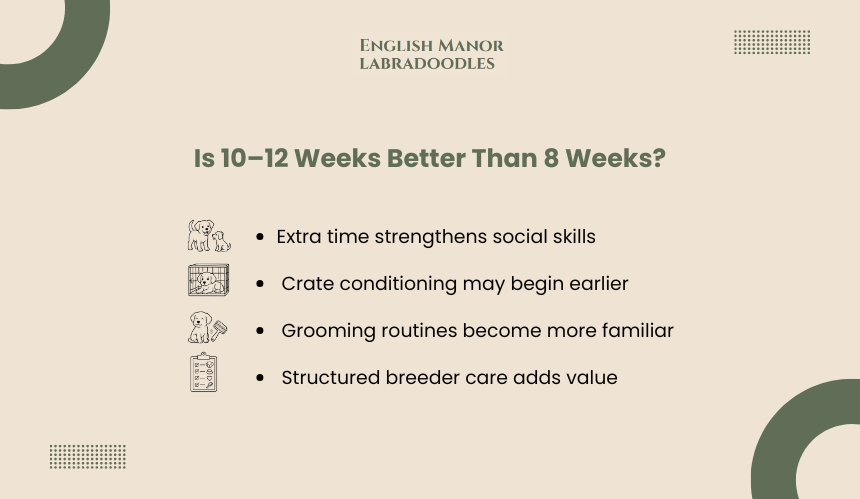
While 8 weeks is widely considered the minimum appropriate age, some breeders and families choose to wait until 10–12 weeks before bringing a puppy home. This extended time can offer additional social and environmental exposure, depending on the breeder’s program.
Did You Know?
The socialization window begins to gradually close around 12–14 weeks of age, meaning early exposure during this period has a lasting impact on confidence and adaptability.
What Are the Potential Benefits of Waiting Until 10–12 Weeks?
When a puppy remains with a responsible breeder during this period, it may receive:
- Continued litter interaction for advanced bite control
- Early crate conditioning
- Introduction to grooming routines
- Exposure to household sounds and surfaces
- Preliminary temperament evaluation
This can help identify personality traits such as confidence, sensitivity, and energy level, which are useful for matching the puppy to the right family.
Are There Any Trade-Offs?
Waiting longer can slightly delay early bonding with the new owner. Because attachment begins to form rapidly around 8 weeks, families who adopt later should focus intentionally on positive interactions, routine-building, and consistent training to establish trust.
Ultimately, whether 8 weeks or 10–12 weeks is ideal depends on the quality of care provided during that extra time. A structured breeder program adds value; passive waiting does not.
Next, it’s important to understand what risks are associated with bringing a puppy home too early.
What Happens If a Puppy Is Taken Home Too Early?
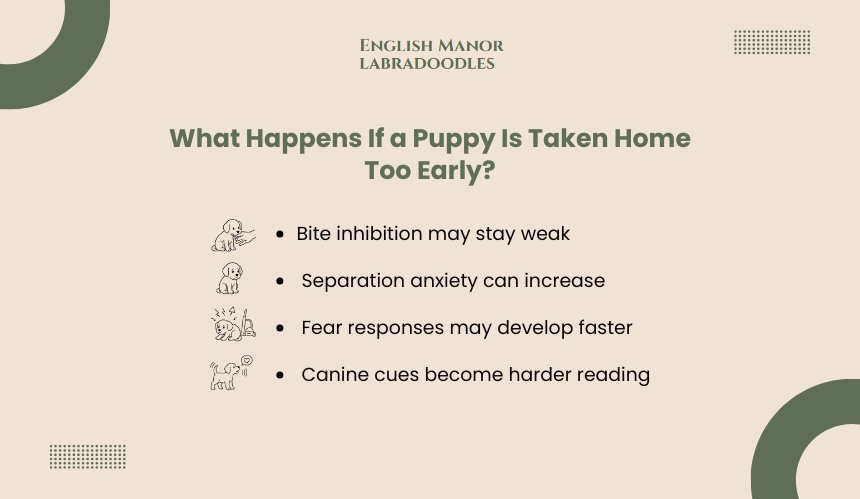
Bringing a puppy home before 8 weeks may seem harmless, but early separation can interrupt critical developmental learning that shapes long-term behavior. During the final weeks with their mother and littermates, puppies refine social boundaries, frustration tolerance, and communication skills that are difficult to replicate in a human-only setting.
Did You Know?
Research in canine behavioral studies indicates that puppies separated before 8 weeks are more likely to display increased anxiety, noise sensitivity, and difficulty with impulse control later in life.
What Behavioral Challenges Can Develop?
Early separation may contribute to:
- Poor bite inhibition due to a lack of litter correction
- Increased separation anxiety
- Heightened fear responses to new environments
- Excessive barking or attention-seeking behavior
- Difficulty reading canine social cues
These behaviors are not guaranteed, but the risk increases when foundational social learning is shortened.
Why Can’t Owners Replace Litter Learning?
Littermates teach through immediate feedback. When a puppy bites too hard, another puppy reacts instantly. That social correction is consistent and repetitive, something humans cannot fully duplicate. The mother also reinforces boundaries and emotional regulation through subtle behavioral cues.
Removing a puppy too early interrupts these natural lessons at a time when the brain is highly impressionable.
Understanding these risks reinforces why developmental timing matters, especially for intelligent, social breeds like the Labradoodle. Next, we’ll explore whether this hybrid breed has any specific considerations regarding adoption age.
Are There Special Considerations for Labradoodles?
Labradoodle puppies combine the intelligence of the Poodle with the sociability of the Labrador Retriever. This hybrid often results in a highly trainable, energetic, and people-oriented dog — but those same traits make early developmental timing especially important.
Did You Know?
Both parent breeds consistently rank among the most intelligent and trainable, suggesting that early experiences strongly influence long-term behavior patterns.
Why Is Early Socialization Critical for Labradoodles?
Labradoodles tend to form strong attachments to their families. When properly socialized during the 8–12 week window, they typically develop into confident, adaptable companions. However, inadequate early exposure may increase the likelihood of:
- Separation anxiety
- Overexcitement around guests
- Jumping or impulse-control challenges
- Sensitivity to new environments
Because they are highly responsive learners, positive early experiences, such as gentle handling, sound exposure, and structured play, create lasting behavioral benefits.
Does Grooming Preparation Matter at This Age?
Labradoodles often have curly or wavy coats that require regular grooming. Puppies who are gently introduced to brushing, nail trimming, and handling between 8–12 weeks adapt more easily to lifelong grooming routines.
Are They Ready for Training at 8 Weeks?
Yes, Labradoodle puppies can begin basic crate training, name recognition, and simple commands as early as 8 weeks old. Their intelligence makes early structure beneficial, provided training remains short, positive, and consistent.
Understanding breed-specific traits reinforces why the 8–10 week window is widely recommended: it balances social stability with optimal bonding and training readiness.
Next, we’ll outline how owners should prepare before bringing a Labradoodle puppy home.
How Should Owners Prepare Before Bringing a Labradoodle Puppy Home?
Bringing a Labradoodle puppy home at the right age is only part of the equation. Preparation during the days and weeks before arrival plays a major role in shaping a smooth transition. The first 72 hours in a new environment can influence stress levels, bonding, and early learning patterns.
Did You Know?
Puppies adapt more confidently to new homes when routines, including feeding, sleep, and bathroom breaks, are introduced consistently from day one.
What Should Be Ready Before Pickup Day?
Owners should prepare:
- A properly sized crate for safe sleeping and early crate training
- A quiet, designated sleeping area away from heavy foot traffic
- Puppy-safe chew toys to redirect teething behavior
- Stainless steel food and water bowls
- Age-appropriate puppy food (matching breeder’s current diet)
- A collar with an ID tag
Consistency in food and sleeping arrangements reduces digestive upset and anxiety during the transition.
When Should the First Veterinary Visit Occur?
A veterinary appointment should be scheduled within 48–72 hours of bringing the puppy home. This initial exam confirms overall health, reviews vaccination records, and establishes a vaccination schedule for continued care.
Most puppies begin their vaccination series around 6–8 weeks, with boosters administered every 3–4 weeks until approximately 16 weeks of age.
How Should the First Week Be Structured?
The first week should focus on:
- Establishing a predictable feeding and bathroom routine
- Gentle exposure to household sounds
- Short, positive crate sessions
- Calm introductions to family members
- Limited exposure to high-risk public areas until vaccination protection increases
Avoid overwhelming the puppy with visitors or excessive stimulation during the adjustment period.
Thoughtful preparation ensures that when the puppy arrives at the ideal age, typically 8–10 weeks, the transition supports bonding, confidence, and long-term behavioral success.
Next, we’ll conclude with key takeaways, then address common questions about bringing a Labradoodle puppy home.
Final Takeaways: Choosing the Right Time for a Strong Start
The best age to bring a Labradoodle puppy home is typically between 8 and 10 weeks. This window allows for essential social development with littermates while ensuring the puppy is young enough to bond deeply with a new family and begin structured training.
Puppies removed too early may face increased behavioral challenges, including poor bite inhibition and anxiety. Waiting until at least 8 weeks supports emotional regulation, social confidence, and smoother household adaptation. In some cases, remaining with a responsible breeder until 10–12 weeks can provide additional structured exposure and early conditioning.
Ultimately, timing influences long-term temperament more than many new owners realize. When developmental readiness aligns with proper preparation at home, the transition becomes less stressful and sets the foundation for a confident, well-adjusted companion.
Frequently Asked Questions
Can I bring a Labradoodle puppy home at 6 weeks?
Most veterinarians and responsible breeders advise against bringing a puppy home at 6 weeks. At that age, puppies are still refining bite inhibition and social skills through interaction with their mother and littermates. Early separation may increase the likelihood of anxiety and impulse-control challenges later in life.
Is 12 weeks too old to adopt a Labradoodle puppy?
Twelve weeks is not too old, especially if the puppy has remained in a structured, social environment. However, because the primary socialization window begins narrowing after 12–14 weeks, new owners should prioritize positive exposure to people, sounds, and environments immediately after adoption.
How many vaccinations should a puppy have before going home?
Puppies typically receive their first round of core vaccinations between 6 and 8 weeks of age. Booster shots are then administered every 3–4 weeks until approximately 16 weeks. Owners should schedule a veterinary visit within a few days of bringing the puppy home to continue the vaccination plan.
Does waiting longer improve temperament?
Additional time with a responsible breeder between 8 and 12 weeks can support social stability and early conditioning. However, temperament is influenced by genetics, breeder practices, and ongoing socialization at home. Structured exposure and consistent training after adoption remain equally important.
What should I focus on during the first week at home?
The first week should emphasize routine, bonding, and gentle exposure. Establish predictable feeding and bathroom schedules, introduce crate training gradually, and avoid overwhelming social situations. Short, positive experiences build confidence and strengthen attachment during this critical transition period.